Facing the Vienna State Opera on Philharmonikerstraße, Hotel Sacher has occupied one of the city’s most recognisable cultural addresses since 1876. Its story began earlier: in 1832, Franz Sacher created the cake that would carry the family name. His son, Eduard, later brought that legacy into the world of grand hotelkeeping, opening the hotel opposite the Opera. Now celebrating 150 years, Sacher remains privately owned and family-run, with a place in Vienna’s social and cultural life that extends far beyond its celebrated confection. That continuity is central to the hotel’s identity, but Sacher is not a museum of its own past. Its 152 individually designed rooms and suites, restaurants, cafés and bars, Sacher Boutique Spa and personal concierge service bring its heritage into the present. The Opera remains its neighbour, while art, music and the rituals of Viennese coffeehouse culture are woven into the atmosphere of the house. Together, they give the hotel a character shaped as much by its people and service as by its history and setting.
This guide explores Hotel Sacher Vienna as a complete hospitality experience: its architecture and legacy, accommodation, dining, wellness and cultural connections, alongside the practical details that help visitors choose the right room, plan their days and understand the costs of a stay. From the history behind the Sacher name to the finer considerations of booking and timing a visit, the aim is to give readers a well-rounded understanding of one of Vienna’s enduring hotel institutions.
Photos: © Hotel Sacher
Hotel Sacher Vienna
The story of Hotel Sacher Vienna began long before its doors opened. In 1832, 16-year-old apprentice chef Franz Sacher created a chocolate cake with apricot jam for Prince Metternich’s guests. The Original Sacher-Torte would eventually become the family’s most enduring culinary legacy. His son, Eduard Sacher, carried the name into hospitality, first opening a delicatessen shop beside Vienna’s developing State Opera in 1865, before establishing Hotel Sacher at Philharmonikerstraße 4 in 1876. Its location, opposite the Opera House, placed the hotel at the centre of Vienna’s cultural and social life. Yet significant amount of its early identity was shaped by Anna Sacher, who married Eduard in 1880 and assumed responsibility for the hotel following his death in 1892. Under her direction, Sacher became a meeting place for aristocrats, politicians, artists and international visitors. Known for her formidable character, cigar and French bulldogs, Anna was also a determined businesswoman who understood that a hotel’s reputation rested as much on its service and discretion as its address. She even invited distinguished guests to sign tablecloths, embroidering their signatures herself; one surviving example bears the name of Emperor Franz Joseph.
Following Anna’s death in 1930, the hotel entered another chapter when the Gürtler and Siller families acquired it in 1934. The Second World War brought further disruption, with the property passing under Soviet and then British control before the families regained possession in 1951. In 1962, following the death of co-owner Anna Siller, the Gürtler family became the hotel’s sole owner. The property has remained privately owned ever since, with the Gürtler and Winkler families continuing its stewardship today.
Across the decades, the hotel has developed beyond its original footprint while retaining its historic identity. Its rooms, dining spaces and services have evolved to meet the expectations of contemporary hospitality, but the relationship with Vienna’s cultural life remains central. The hotel is also a member of The Leading Hotels of the World. The 150th anniversary in 2026 brought that connection between heritage and contemporary culture into focus through a collaboration with Austrian artist Erwin Wurm. His sculptures Step Big and Dancer, displayed outside the hotel from March to November, offered a modern artistic presence at one of Vienna’s most recognisable addresses.
A century and a half after Eduard Sacher opened its doors, the hotel’s identity still reflects several generations of ambition and stewardship: Franz’s culinary invention, Eduard’s vision for a grand hotel, Anna’s influence on its hospitality traditions and the families who have continued its development. Its history is ultimately one of continuity, shaped by the people who have maintained its place in Vienna’s cultural and social life.
Photo: © Adrian Gaut / Hotel Sacher
Rooms & Suites
Hotel Sacher Vienna has 152 rooms and suites, arranged across 12 publicly listed accommodation categories. Their interiors were developed by co-owner Alexandra Winkler in collaboration with French designer Pierre-Yves Rochon, whose work brings together the hotel’s historic character and contemporary residential comfort. The result is a collection of individually designed spaces, with selected artworks, collected furniture, crystal chandeliers, fine textiles, parquet flooring and marble bathrooms. The rooms are not identical in layout or outlook, and this distinction becomes particularly important when choosing between categories.
Across the accommodation, guests have a complimentary minibar stocked with non-alcoholic drinks, an in-room safe, a coffee machine, television with streaming facilities, high-speed Wi-Fi and individually adjustable air conditioning. Most rooms have both a bathtub and a separate shower. Some overlook the Vienna State Opera, the Albertina Museum or Kärntner Straße; others face the quieter Maysedergasse or the hotel’s courtyard. A view should therefore be treated as a genuine part of the room selection rather than an assumed feature of every category.
Rooms & Suites Showcase
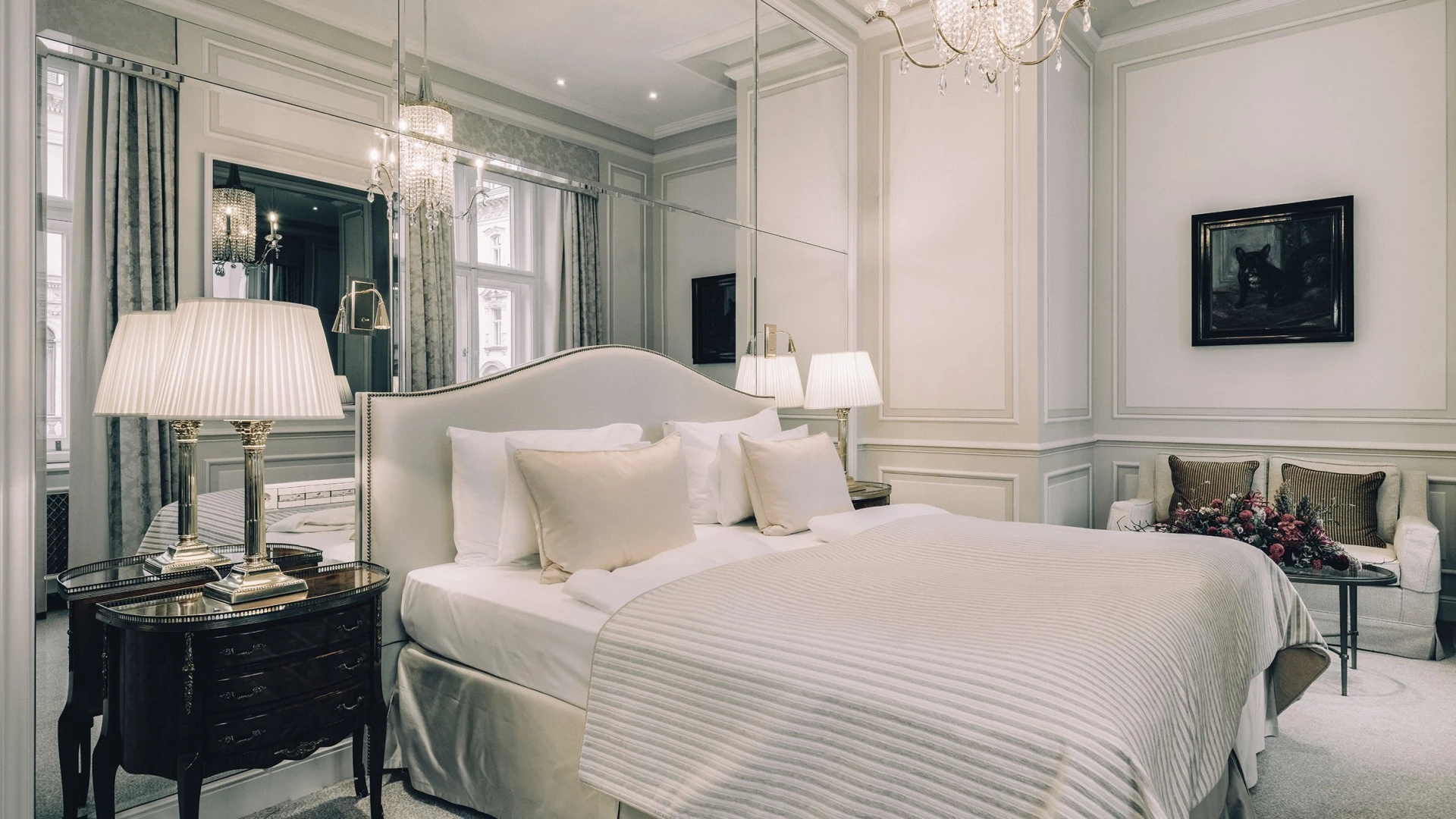
Deluxe Room
The Deluxe Room is the hotel’s entry-level category, although its dimensions of 27–39 m² place it above what many city-centre hotels offer at their starting level. Each room is individually arranged, with carefully selected furniture, original or collectible artwork, refined textiles and a traditional interior vocabulary that feels appropriate to the building. King-size or twin beds are available, making the category practical for both couples and friends travelling together. Marble bathrooms and contemporary room facilities complete the arrangement, while the absence of a guaranteed iconic view is the main consideration when comparing it with the Deluxe Room with View.
Best suited to couples and solo travellers, as well as friends sharing twin beds; families should enquire about connecting rooms or suitable arrangements for children.
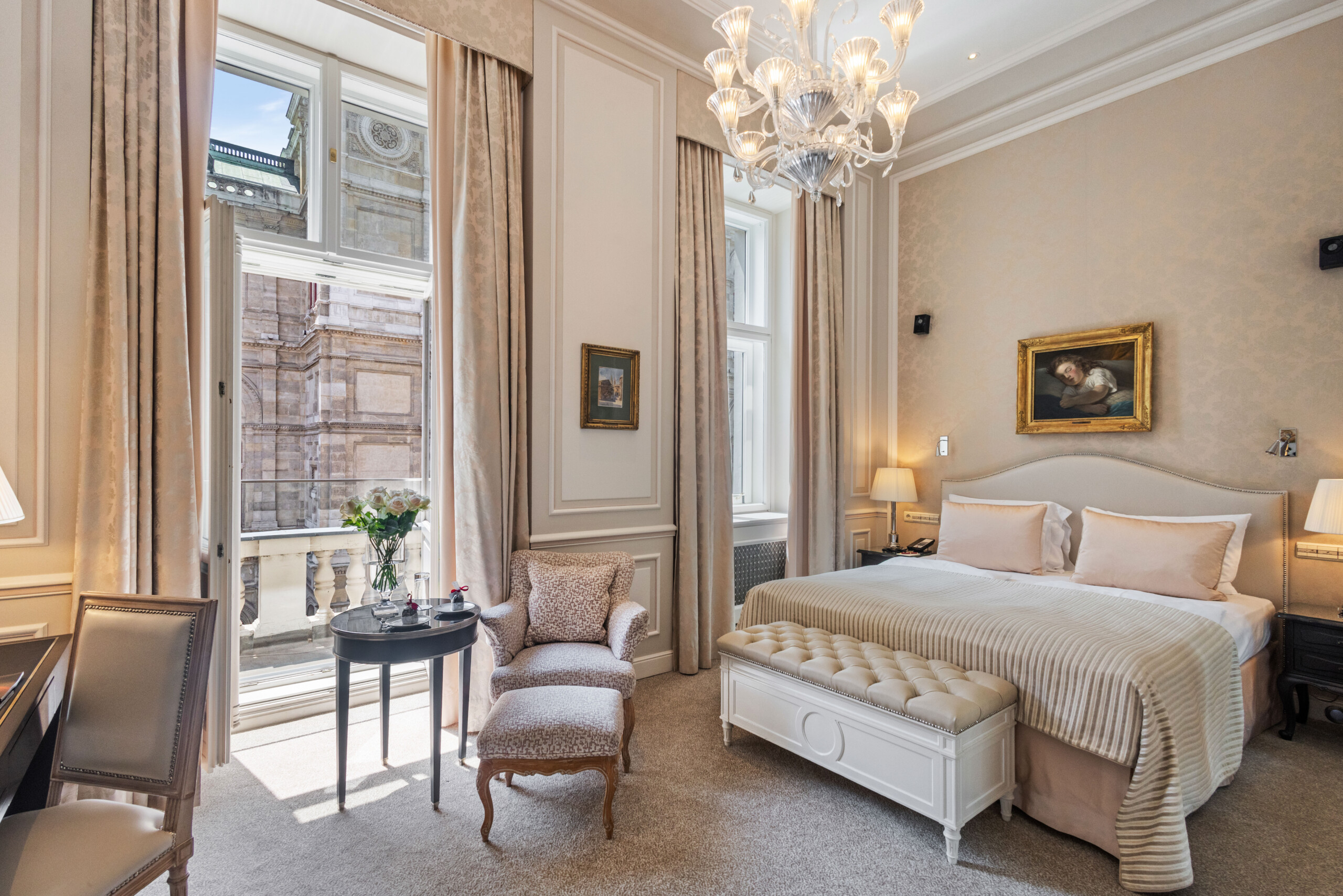
Deluxe Room with View
For guests who would like the city to become part of their room experience, the Deluxe Room with View offers the same 27–39 m² footprint with a more distinctive outlook. Depending on the room allocated, windows look towards the Vienna State Opera, the Albertina Museum or Kärntner Straße, placing some of the city’s most recognisable architectural and cultural landmarks within view. The interior retains the individual furnishings, artwork and marble bathroom of the Deluxe category, with a choice of king-size or twin beds. The difference is not additional floor space, but the relationship between the room and its surroundings: a particularly worthwhile consideration for visitors who expect to spend time enjoying the hotel itself rather than using it solely as a base for sightseeing.
Best suited to couples and solo travellers who value a city view; friends can also choose the twin configuration, while families should confirm rooming arrangements in advance.
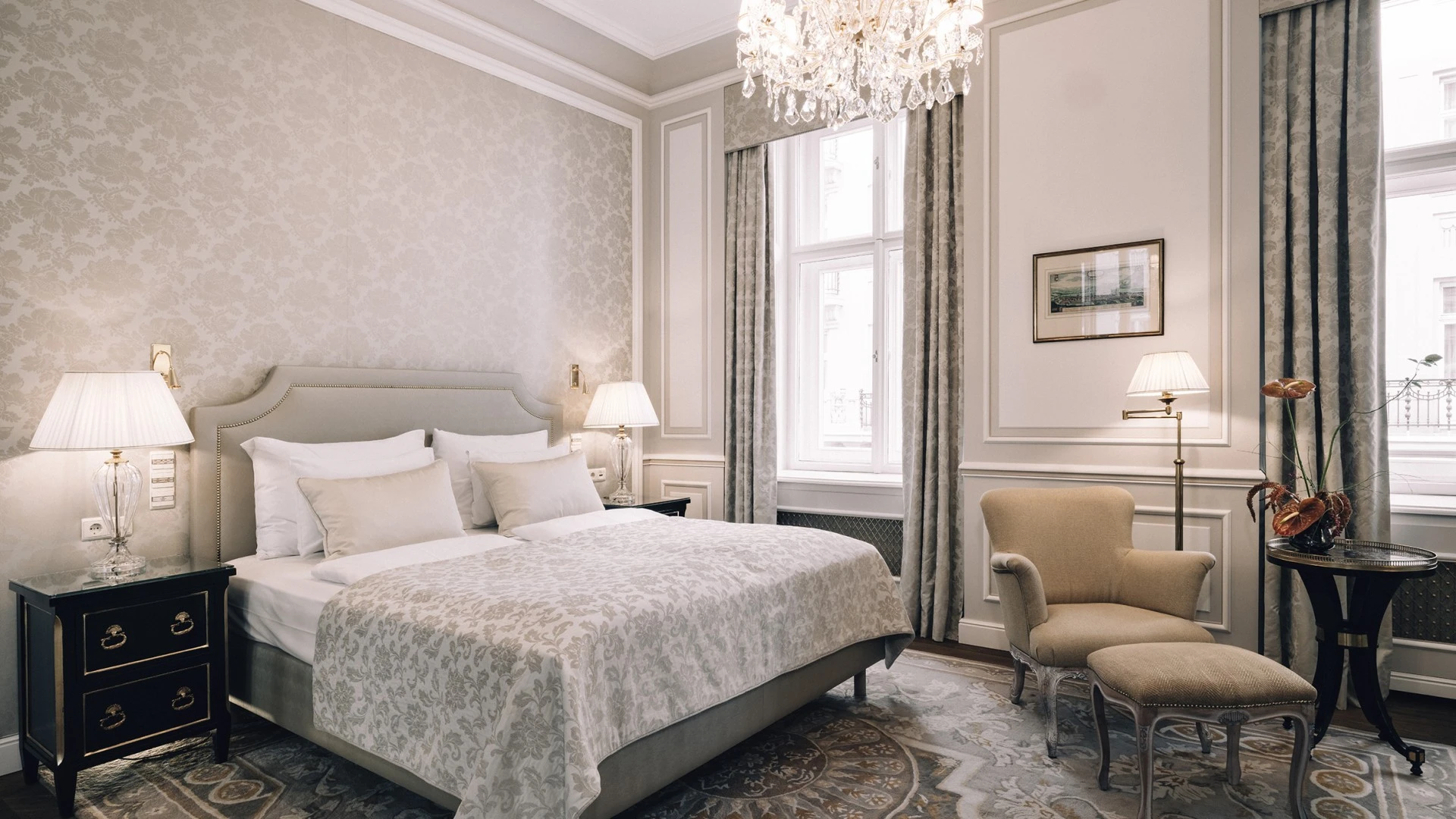
Junior Suite
At 40–55 m², the Junior Suite offers a more generous arrangement, with sleeping and living areas brought together within a single, spacious interior. A comfortable seating area provides somewhere to read, work or spend time between outings, without requiring guests to move into a separate living room. The design continues the hotel’s use of selected furniture, decorative details and artwork, while the marble bathroom features underfloor heating, a separate shower and a bathtub. This category makes particular sense for visitors staying several nights, when a little more room can change the rhythm of a city break. It is also the entry point for families who need an additional bed, subject to the hotel’s arrangements and room capacity.
Best suited to couples and solo travellers seeking more space, and small families with a child requiring an extra bed.
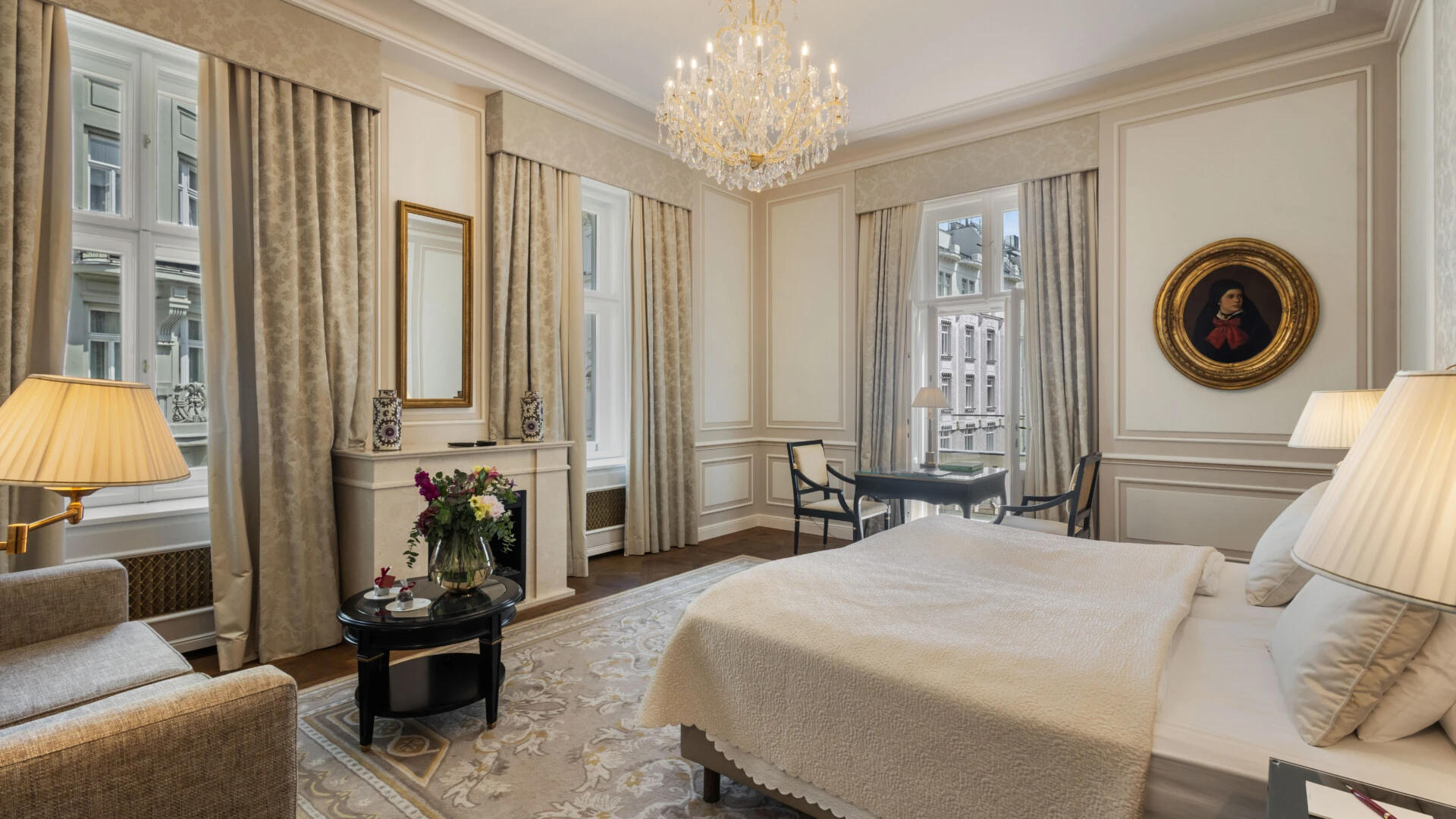
Junior Suite with View
The Junior Suite with View retains the 40–55 m² dimensions and combined sleeping and living arrangement of the standard Junior Suite, but adds an outlook towards the Vienna State Opera, the Albertina or Kärntner Straße, depending on the room. Inside, the emphasis remains on generous proportions, parquet flooring, carefully selected furnishings and a marble bathroom. The seating area provides useful separation within the room, although it is not the same as having a fully independent living room. For a longer stay, the added view can make the room feel more connected to Vienna’s architectural life, particularly for guests who enjoy watching the city change throughout the day.
Best suited to couples and solo travellers who want the additional space and a unique view; small families can also consider it, subject to an approved extra-bed arrangement.
Signature Suite
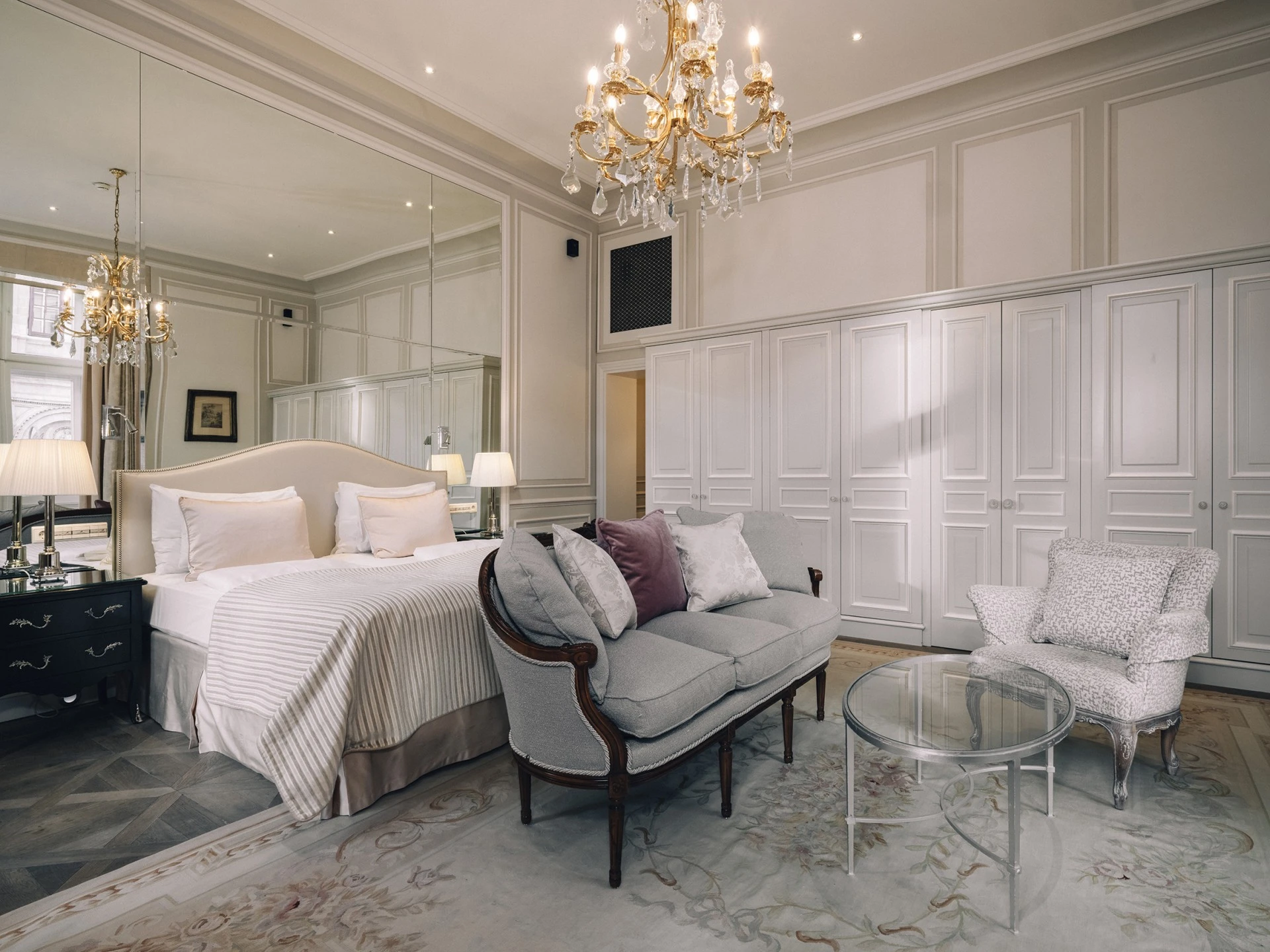
The Signature Suite has a more substantial change in layout, with 50–65 m² and distinct living and sleeping areas. Instead of a seating corner incorporated into the bedroom, guests have a more clearly defined space for relaxing, reading, working or receiving visitors. Selected artworks and carefully chosen furnishings give each suite its own character, while the marble bathroom continues the material language found throughout the property. It is a sensible choice for guests who intend to spend more time in their accommodation, whether on a longer city visit or a special occasion. The additional living space also offers a greater degree of separation for those travelling together.
Best suited to couples and solo travellers who appreciate a separate living area; small families may also find it practical, depending on the extra-bed arrangement.
Signature Suite with View
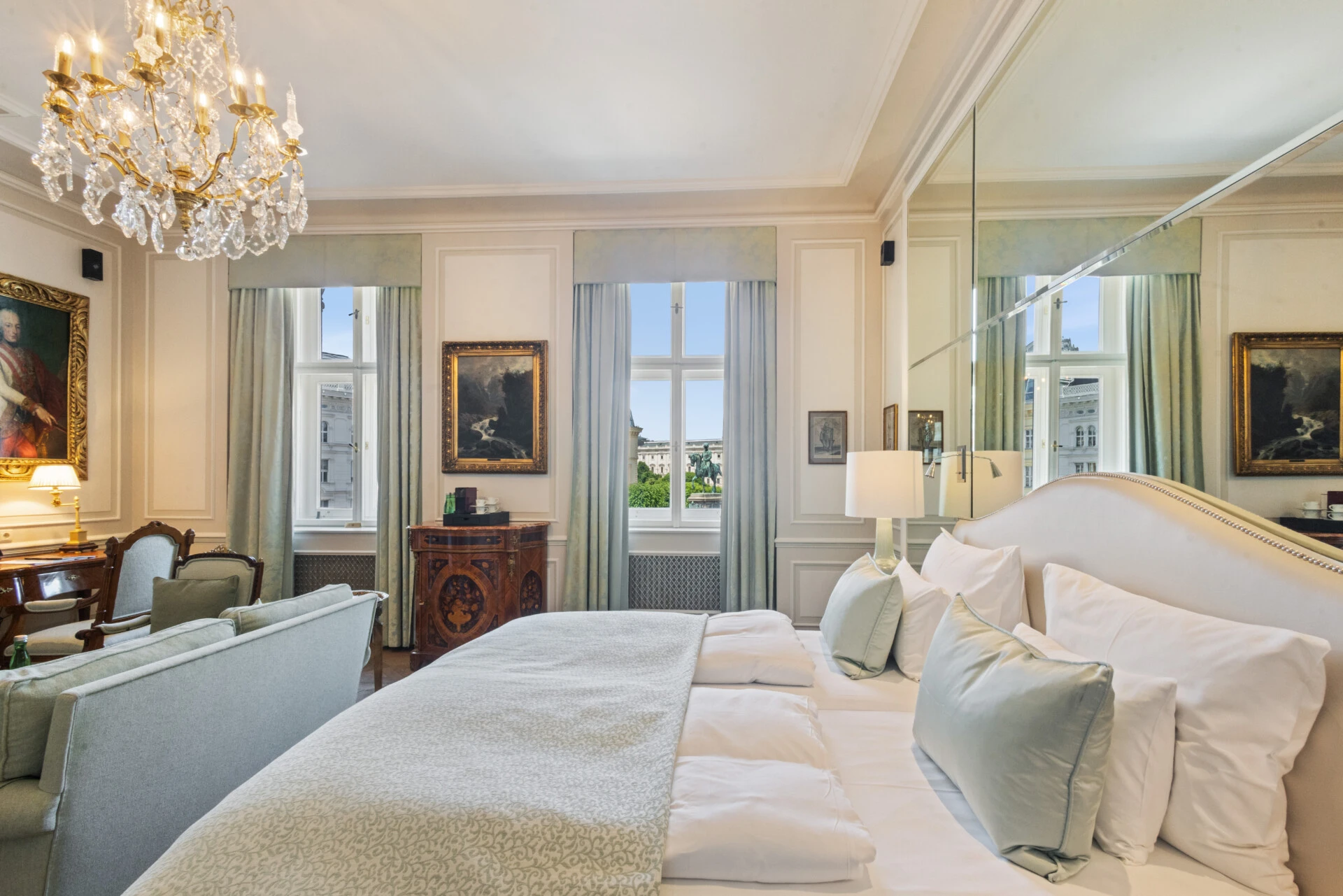
The Signature Suite with View combines the separate living and sleeping areas of the Signature category with an outlook towards one of Vienna’s principal landmarks. At 50–65 m², it offers room to settle into the city without giving up the sense of privacy that comes with a separate living space. Depending on the particular suite, the view may take in the State Opera, the Albertina Museum or Kärntner Straße. Its design follows the hotel’s individual approach to interiors, with carefully selected artworks, quality furnishings and a generous marble bathroom. For guests comparing the Signature categories, this is the option to consider when the view matters as much as the additional space.
Best suited to couples and solo travellers seeking a more spacious stay with a city-facing outlook; small families can enquire about additional sleeping arrangements.
Signature Suite with Terrace View
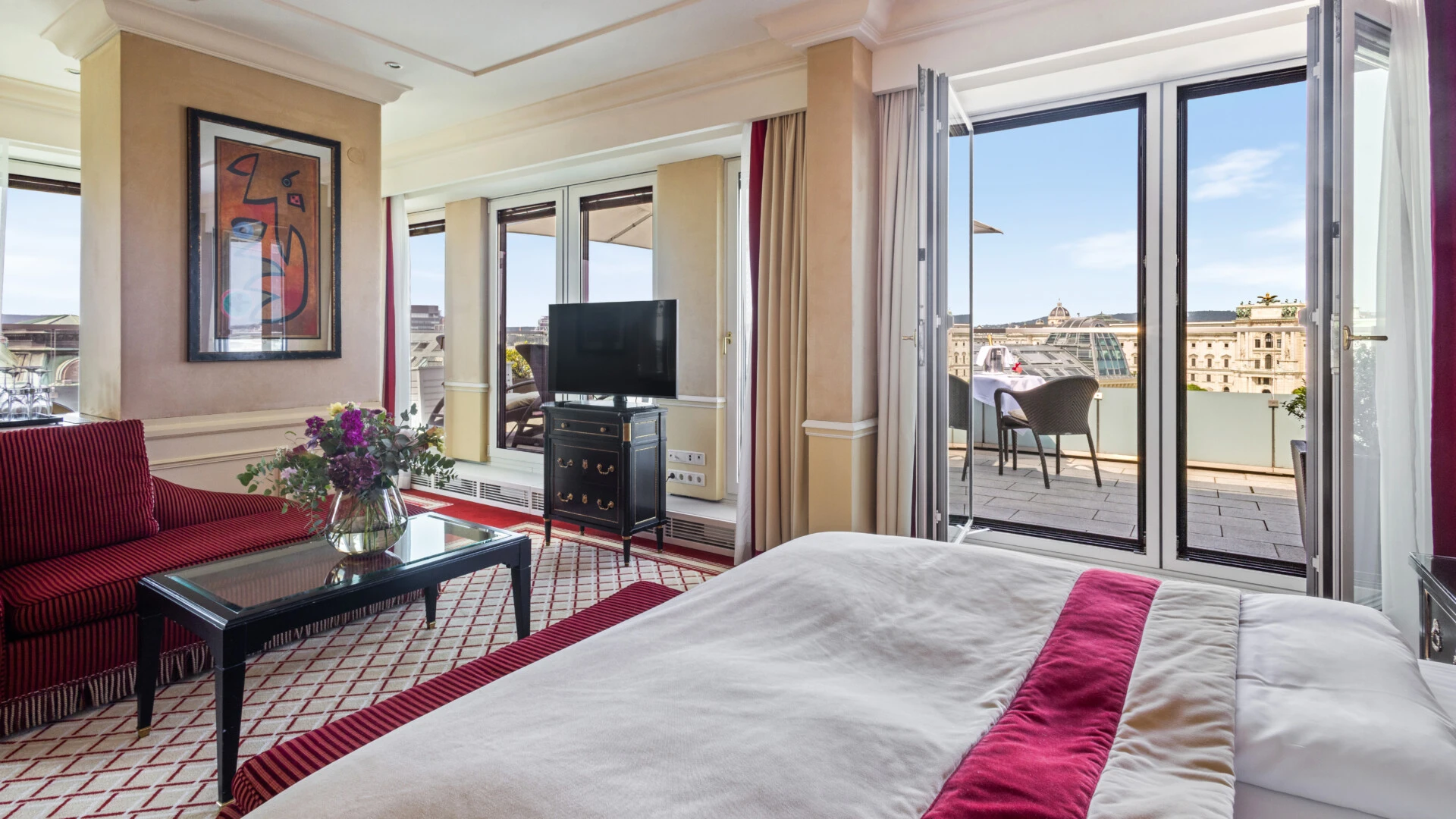
The Signature Suite with Terrace adds an outdoor dimension to the 50–65 m² Signature layout. Alongside its separate living and sleeping areas, the suite has a private terrace with views across Vienna, offering space to sit outside above the city rather than relying entirely on the hotel’s public areas. The interior retains the refined furnishings and marble bathroom found in the other Signature Suites, while the terrace changes how the accommodation can be enjoyed, particularly during spring and summer. It is an appealing choice for guests who value a private outdoor setting after a day among museums, concert halls and the streets of the Innere Stadt.
Best suited to couples seeking a more private and leisurely city stay, and solo travellers who value outdoor space; families should confirm the available bed configuration.
Grand Signature Suite with View
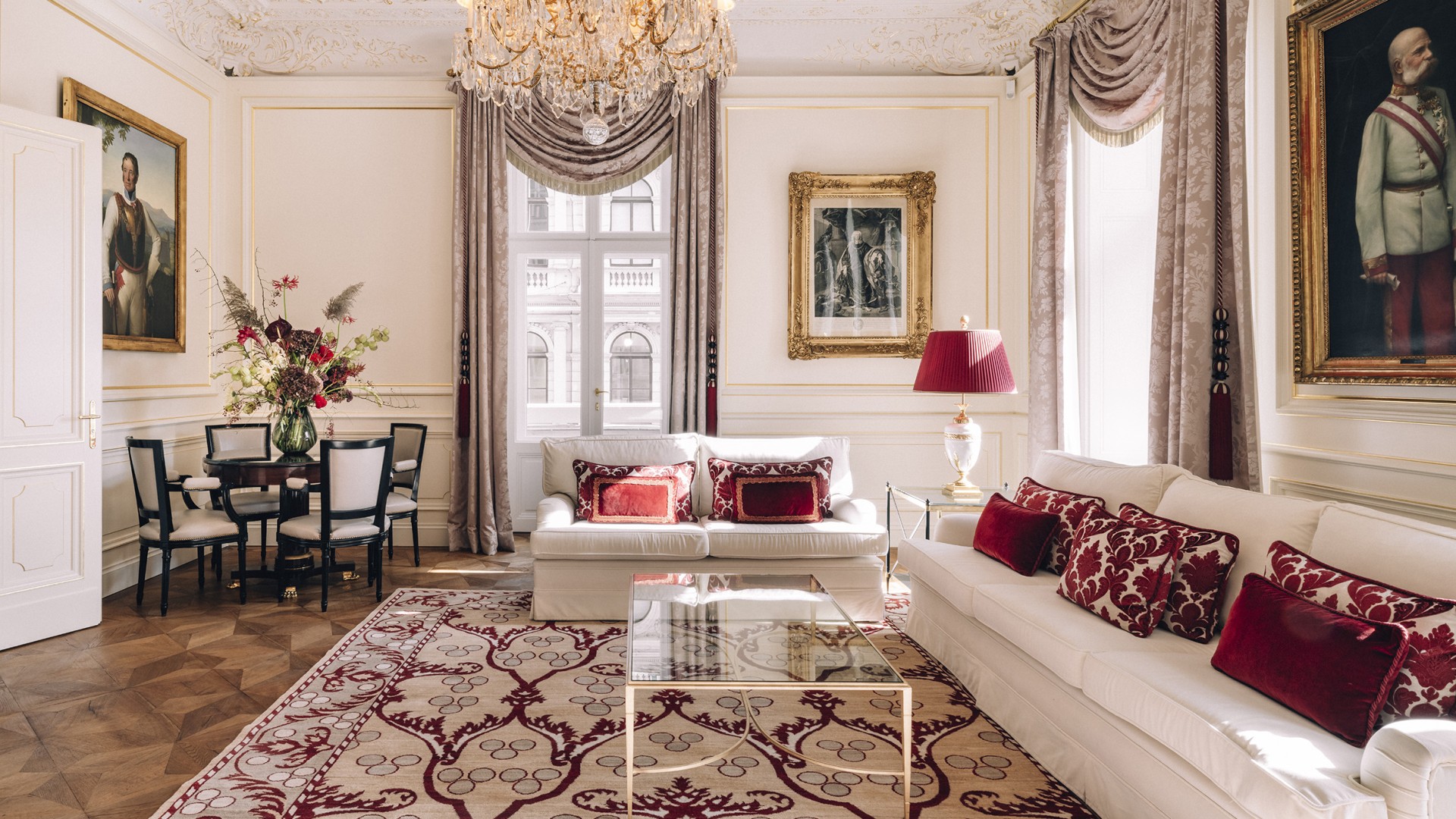
Beginning at 95 m², the Grand Signature Suite with View introduces a considerably larger residential arrangement, with separate sleeping and living areas and a private living room. The additional space makes it possible to move between the bedroom, seating areas and bathroom without the suite feeling like a single hotel room with an enlarged sitting corner. Its outlook includes the Vienna State Opera or St Stephen’s Cathedral, depending on the allocation. The interiors retain Sacher’s established design language, with carefully selected furniture, decorative details and artworks, while the scale gives the suite a more pronounced private-residence character. It is an especially suitable choice for a longer stay or for guests who want the comfort of a substantial suite without moving into the presidential categories.
Best suited to couples and solo travellers who value space and privacy, as well as small families who need a separate living area.
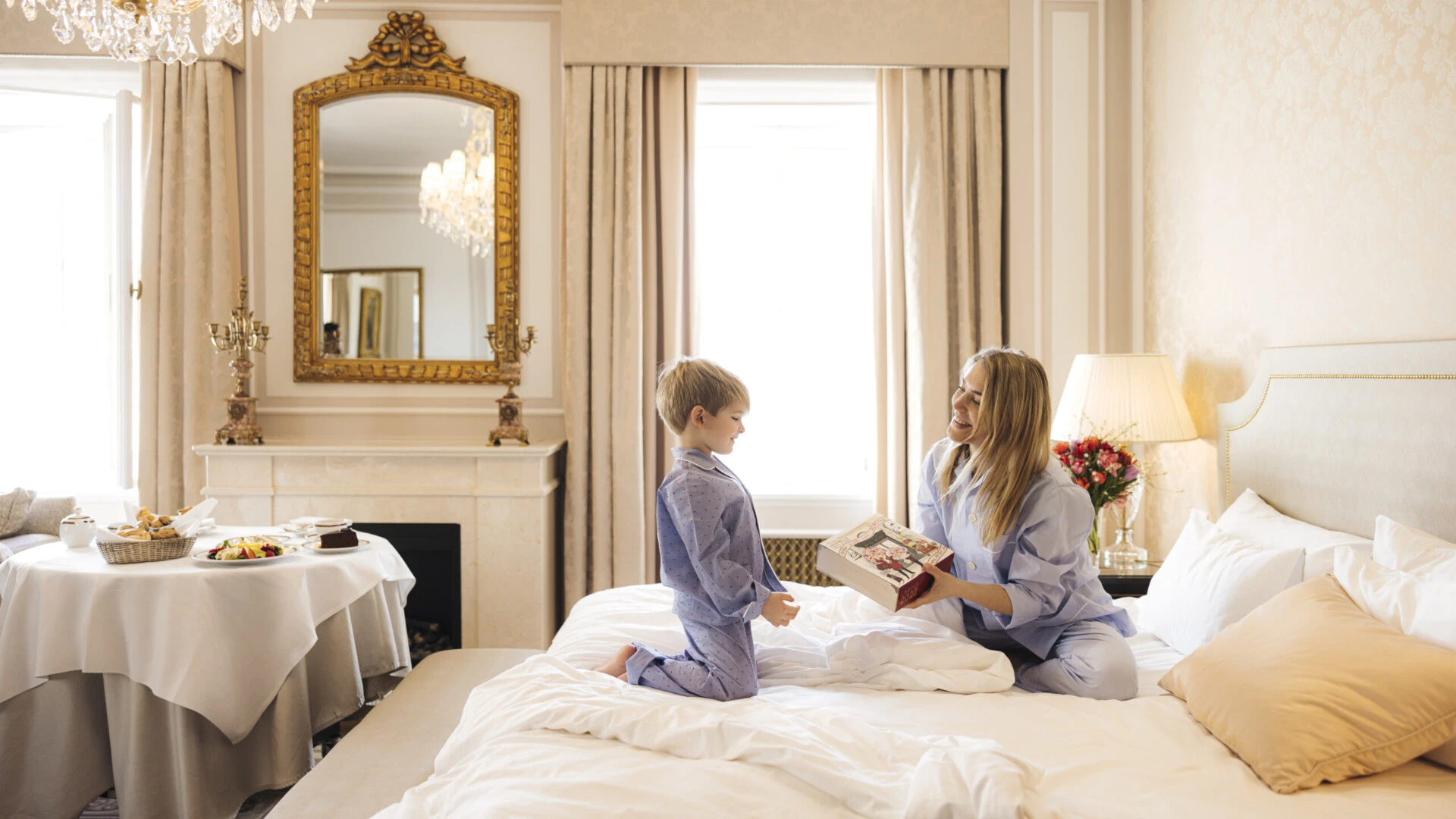
Family Suite
Designed around the practicalities of travelling together, the Family Suite spans 144–148 m² and is arranged across three separate bedrooms and a shared living room. Two of the bedrooms connect directly, while the third is accessed through the entrance hall, allowing different generations or family members to have their own sleeping space without losing the convenience of a shared central area. The official configuration includes three king-size beds, with additional rollaway arrangements available. The hotel lists capacity for up to nine guests, making this the most suitable option for larger families or groups who would otherwise need to reserve several separate rooms. Its size also gives families room to spend time together without having to use the bedrooms as their only shared space.
Best suited to families, multi-generational groups and friends travelling together; it is not primarily designed for a couple or solo traveller.
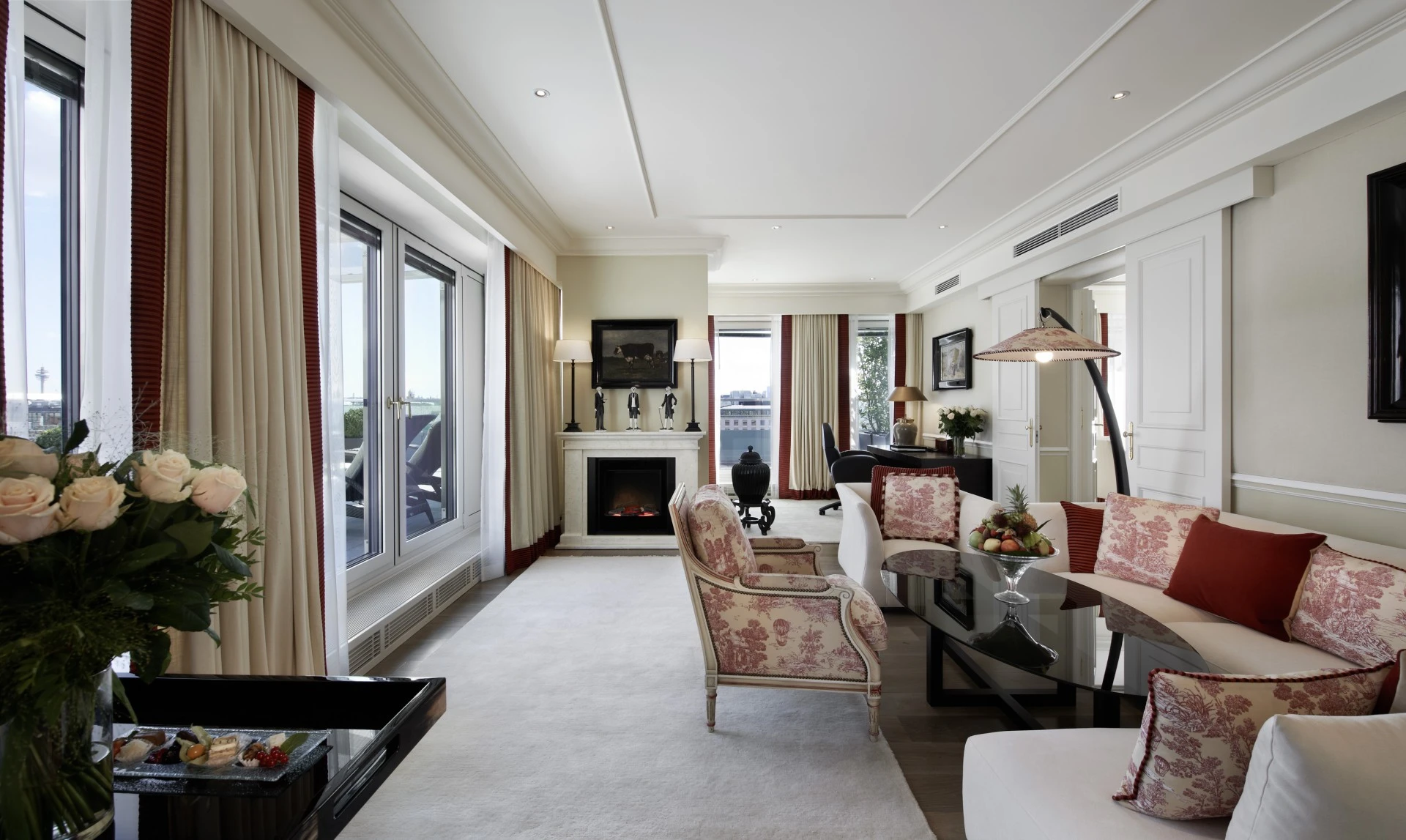
Opera Penthouse Suite
The Opera Penthouse Suite places outdoor living and the city’s architecture at the centre of its accommodation. It has a spacious private terrace with views towards the Vienna State Opera, the Albertina Museum and St Stephen’s Cathedral. Inside, the layout comprises two bedrooms and two bathrooms, alongside separate living and dining areas, a fireplace, a walk-in wardrobe and a generously sized desk. The terrace is furnished for spending time outdoors, with a large dining table that makes it particularly appealing during the warmer months. Unlike a conventional suite with a balcony, this is a substantial multi-room arrangement, allowing guests to entertain, dine or simply spend time together while keeping the sleeping areas separate.
Best suited to families or two couples travelling together; couples seeking a particularly spacious private residence may also appreciate it, while it would be an unnecessarily large choice for most solo stays.
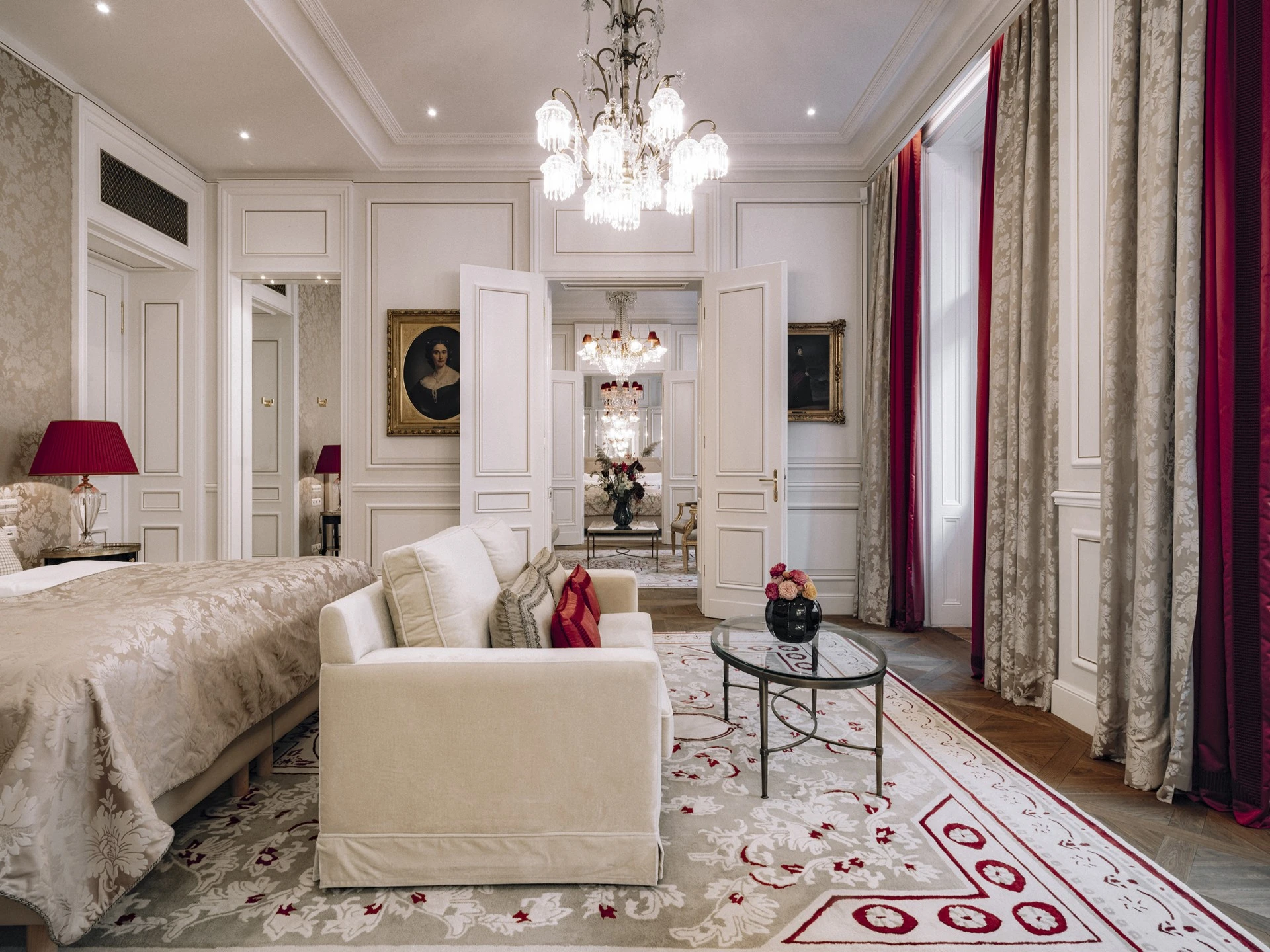
Madame Butterfly Suite
Named after Puccini’s opera, the Madame Butterfly Suite is one of the hotel’s two presidential suites and occupies approximately 180 m². Its design gives particular attention to the relationship between art, architecture and residential comfort: a fireplace, a substantial dining table, a separate study, original artworks, fine carpets and parquet flooring all contribute to its character. The suite also enjoys an almost 360-degree outlook over Vienna, making the city’s historic roofscape and architectural landmarks part of the experience. The Leading Hotels of the World listing additionally describes a two-bedroom arrangement and kitchenette, details that make the suite suitable for guests who need more than a conventional bedroom and sitting room. Its name and scale place it among the hotel’s most distinctive expressions of its connection with opera and the performing arts.
Best suited to couples celebrating a significant occasion, families or two couples who want separate bedrooms and generous shared space; its size makes it less practical for a solo traveller.
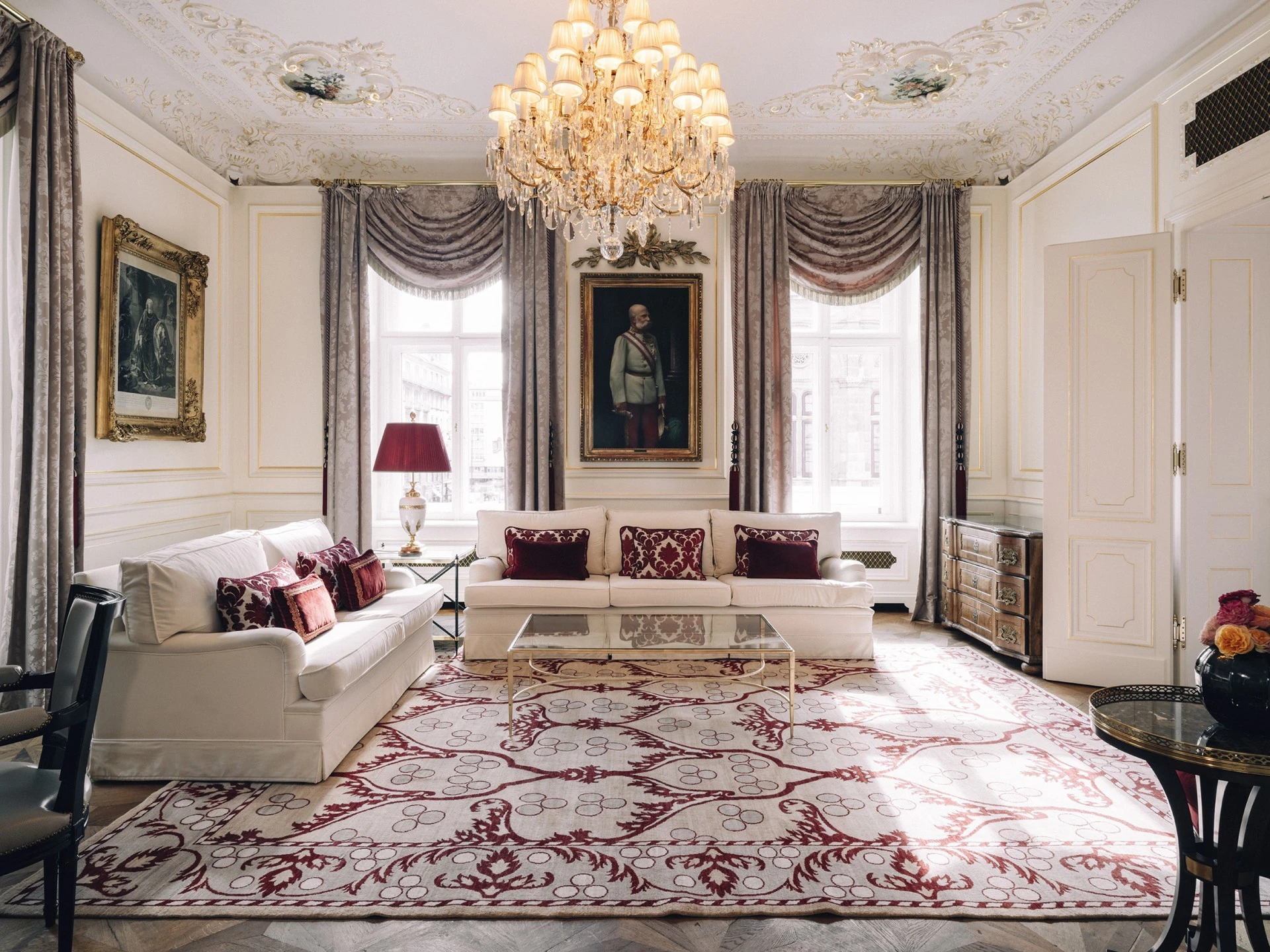
Wiener Philharmoniker Suite
The Wiener Philharmoniker Suite, the hotel’s second presidential suite, occupies 155 m² and takes its name from the Vienna Philharmonic Orchestra. Its two-bedroom layout includes an entrance hall, an elegant living salon, two bathrooms, a fully equipped kitchenette and a marble bathroom with a freestanding bathtub. Yet the most compelling aspect is not its size alone. The suite preserves a notable part of the building’s architectural history: historic parquet flooring dating from 1878 was restored in 2017, when an older Viennese star-parquet floor was rediscovered beneath later layers. A decorative stucco ceiling from around 1900 and a finely crafted tiled stove add further evidence of the property’s original craftsmanship. The view towards the Vienna State Opera reinforces the musical association, giving the suite a particularly strong connection with the cultural life of the city.
Best suited to families or two couples who value separate bedrooms, and to guests with a particular interest in Vienna’s music and architectural heritage.
Photo: © Adrian Gaut / Hotel Sacher
Restaurants, Cafés & Bars
Dining at Hotel Sacher Vienna extends across two restaurants, two cafés, two bars and a seasonal outdoor garden, each with its own atmosphere and purpose. The choice ranges from traditional Austrian cooking served beneath crystal chandeliers to international haute cuisine, an afternoon of Viennese coffee and pastry, or a cocktail before an evening at the State Opera. Together, these spaces give the hotel a culinary identity that reaches well beyond its most famous cake.
The the unique difference and overall feeling and experience between them is worth understanding before making a reservation. Restaurant Rote Bar is the address for Viennese classics, while Grüne Bar takes a more contemporary international approach to fine dining. Blaue Bar is built around cocktails and the rituals of the aperitif; Café Sacher preserves the atmosphere of a traditional Viennese coffeehouse, while Café Bel Étage offers a more contemporary interpretation. Salon Sacher brings afternoon tea and Italian aperitivo into the same setting, and the Summer Garden takes the hotel’s bar experience outdoors during the warmer months.
Photo: © Adrian Gaut / Hotel Sacher
Restaurant Rote Bar
The Rote Bar is the hotel’s address for Austrian cooking, served in a dining room of deep-red damask, large oil paintings and crystal chandeliers. Its glass winter garden looks directly towards the Vienna State Opera, with the glass fronts opened during warmer weather. The kitchen, led by Executive Chef Anton Pozeg, gives traditional dishes a polished treatment, including Wiener Schnitzel, beef roulade, Sacher Tafelspitz and an Original Sacher goose-liver tart. A pianist performs every evening from 19:00, making the restaurant particularly suited to dinner before or after an opera performance. The three-course menu is €75, with a wine accompaniment at €35; individual main courses include Wiener Schnitzel at €39 and braised lamb shank at €32. Rote Bar also holds three toques in the Gault&Millau Guide 2027.
Photo: © Adrian Gaut / Hotel Sacher
Restaurant Grüne Bar
The Grüne Bar takes a more international approach to fine dining, combining seasonal and regional ingredients with haute cuisine. Its deep-green interiors contain original paintings by Austrian modernist Anton Faistauer, twentieth-century Herend porcelain and a particularly significant collection of Lobmeyr crystal chandeliers. One of the world’s early electrified crystal chandeliers illuminated the room in 1883, making the lighting itself part of the hotel’s design history. Executive Chef Anton Pozeg and Sergio Merolla lead a kitchen offering a six-course chef’s menu alongside à-la-carte dishes featuring ingredients such as Breton lobster and Wagyu beef, with vegetarian and vegan choices also available. A Martini prepared at the table adds a small element of theatre to the meal. The restaurant holds three Gault&Millau toques in the 2027 guide and is included in the MICHELIN Guide’s restaurant selection, without Michelin stars.
Photo: © Adrian Gaut / Hotel Sacher
Blaue Bar
With deep-blue damask walls, velvet seating, a mirrored bar and crystal chandeliers, the Blaue Bar is one of Sacher’s most intimate settings. It sits beside the hotel’s protected historic lobby, which dates to 1876, and has become a natural meeting point for guests attending the nearby Opera. The emphasis is on classic cocktails, champagne and contemporary mixology, with signatures such as the Anna Sacher and Sacher Cocktail drawing on the house’s association with apricot and chocolate. Current cocktail prices generally sit around €18–22, with the Sacher Cocktail at €20 and the Champagne Cocktail at €26. Open until 01:00 from Thursday to Saturday, it is also one of the hotel’s livelier options for a later evening.
Photo: © Adrian Gaut / Hotel Sacher
Café Sacher Wien
Café Sacher is the hotel’s celebrated Viennese coffeehouse, recognisable for its red velvet seating, marble tables, chandeliers and traditional service. Alongside breakfast and Austrian dishes, its central attraction is the Original Sacher-Torte, currently €11.50 with whipped cream; the Sacher Sweet Treat, at €24.50, adds a hot non-alcoholic drink and mineral water. There is also a cinematic connection: the café has served as a filming location for Woman in Gold (2015) and Sachertorte (2022), placing its familiar interiors on screen as well as in the collective image of Vienna. In a nod to Anna Sacher’s affection for French bulldogs, dogs remain welcome. The café opens daily from 07:00 to 23:00.
Photo: © Adrian Gaut / Hotel Sacher
Café Bel Étage
Situated on Kärntner Straße, Café Bel Étage interprets Viennese coffeehouse culture through a more contemporary, two-level design. A large crystal chandelier connects the floors, with high tables and a livelier café atmosphere below and a quieter velvet-seated lounge upstairs, overlooking the direction of the Opera. Portraits of Anna Sacher and her French bulldog Tommy provide a personal link to the hotel’s past. Its menu moves from breakfast and coffee to Austrian classics and contemporary brasserie dishes: beef tartare is €26, Wiener Schnitzel €39.90 and the Original Sacher-Torte €11.50. The café also received one toque in the Gault&Millau Guide 2027, making it an appealing choice for a relaxed meal rather than only a coffee stop.
Photo: © Adrian Gaut / Hotel Sacher
Salon Sacher
Salon Sacher brings together afternoon tea, Viennese hospitality and Italian aperitivo culture in a design inspired by the 1920s and 1950s. Developed in cooperation with Campari, its coral, black and metallic details give the room a more playful character than the hotel’s traditional dining rooms. A historic stucco ceiling, uncovered during the redesign, preserves a piece of the building’s earlier architecture. Its signature Sacher Afternoon Tea includes finger sandwiches, scones with clotted cream, Original Sacher cubes, tea and a glass of champagne. It costs €89 per person and is served Thursday to Monday at 13:00 or 16:30, with vegetarian and vegan versions available on request. Later, the salon shifts towards cocktails and aperitivo, making it a particularly good choice for an afternoon occasion.
Photo: © Adrian Gaut / Hotel Sacher
Sacher Summer Garden
During summer, the Sacher experience moves outdoors to Maysedergasse, where the Summer Garden looks towards the Albertina and extends the Blaue Bar’s drinks and food offering into an open-air setting. The menu combines cocktails, light summer dishes, the Sacher Petit Beef Burger and Original Sacher-Torte. The 2026 season ran from 1 July to 31 August, daily between 12:00 and 18:00, without reservations. As this is a seasonal venue, visitors planning a future summer should check the hotel’s announcement for the next opening dates rather than assume the same schedule will apply.
Dining at Sacher: What to Choose
For traditional Viennese cooking, choose Rote Bar; for a longer, more elaborate dinner, Grüne Bar is the strongest option. Blaue Bar is suited to cocktails before or after the Opera, Café Sacher to the classic coffeehouse experience, and Bel Étage to a more flexible meal throughout the day. Salon Sacher is the choice for afternoon tea, while the Summer Garden is worth considering when the seasonal terrace is open.
For overnight guests, the breakfast buffet is a separate service and is currently listed at €62.50 per person; whether breakfast is included depends on the room rate booked. The restaurants and afternoon tea are best reserved ahead, especially Grüne Bar and Salon Sacher. Hotel residents and outside visitors can use the dining venues, subject to availability. Menu prices and seasonal schedules can change, so the figures above should be treated as current published indications rather than fixed future rates.
Photos: © Hotel Sacher
The Original Sacher-Torte
A chocolate cake in a wooden box might seem an unlikely addition to a contemporary art collection, but that is precisely what Hotel Sacher has been doing since 2008. Each year, an internationally recognised artist is invited to reinterpret the presentation box of the Original Sacher-Torte, turning a traditional Viennese confection into a limited-edition collectible. For 2026, the collaboration is with American artist KAWS. His selected work, SPOKE TOO SOON (2021), features COMPANION, his recognisable cartoon character, climbing out of a pile of rubble. Produced in a limited edition of 1,000 boxes, the collection has sold out, with proceeds benefiting NF Kinder, an Austrian organisation supporting children affected by neurofibromatosis. Previous editions have featured artists including Robert Longo, Georg Baselitz, Sarah Morris, Gottfried Helnwein and Katherine Bernhardt. It is an unusual meeting of pastry craftsmanship, contemporary art and popular culture, and one that gives the cake a life well beyond the café table.
Franz Sacher’s Original Creation
The confection itself dates to 1832, when 16-year-old apprentice chef Franz Sacher prepared a chocolate dessert for Prince Metternich’s guests. His combination of chocolate sponge and apricot jam became the foundation of the recipe later carried forward by his son, Eduard, who brought the cake into the Sacher business. The modern Original Sacher-Torte is made with chocolate sponge, apricot jam in the middle and beneath the chocolate glaze. Its composition is intentionally restrained: there are no elaborate fillings or layers of cream, and the balance between chocolate and fruit remains central to its identity. The recipe has been closely guarded for generations, with the hotel describing a process of 34 individual steps from preparation through packaging.
The Torte War: Sacher versus Demel
The cake’s reputation eventually became the subject of a dispute almost as famous as the confection itself. During the 1950s and early 1960s, Hotel Sacher and Viennese pastry house Demel contested the right to use the name Original Sacher-Torte, along with differences over the recipe and the placement of the apricot jam. A court decision in 1962 was followed by an agreement in 1963: the designation Original Sacher-Torte was reserved for Hotel Sacher, while Demel continued to sell its own version as Demel’s Sachertorte. The distinction became particularly associated with the filling. Sacher’s cake contains an apricot jam layer inside, whereas Demel’s traditional version was made without that middle layer. The disagreement, known in Vienna as the Tortenkrieg, turned a question of pastry tradition and commercial identity into a long-running legal affair.
The Craft Behind the Cake
Sacher reports that approximately 360,000 Original Sacher-Tortes leave its manufactory each year, destined for customers in Austria and around the world. Despite that volume, the hotel describes the cakes as handmade, using fresh eggs and specially selected chocolate. Their familiar wooden boxes have become part of the presentation, as recognisable as the chocolate seal on the cake itself. The traditional way to serve it is with unsweetened whipped cream, known in Austria as Schlagobers. This is more than a decorative addition: the cream softens the intensity of the chocolate and provides a lighter contrast to the apricot. At Café Sacher Wien, a slice currently costs €11.50.
For those wishing to take a whole cake home, the online shop lists the six-portion size at €95, the nine-portion size at €107 and the twelve-portion size at €115, including VAT but excluding shipping. The cakes should be kept in their original packaging at 16–18°C, away from direct sunlight, and not refrigerated. Their recommended freshness period varies by size, so the date on the individual packaging should be checked.
The Viennese Coffeehouse: More Than a Café
Vienna’s coffeehouse tradition developed from the late seventeenth century, with coffeehouses gradually becoming important social and intellectual meeting places. By 1720, the Kramersches Kaffeehaus on the Graben was already providing newspapers for its guests. Over subsequent centuries, these establishments became places for writers, artists, journalists and public figures to meet, read, debate and spend hours over a single coffee. The tradition is now recognised in Austria’s National Inventory of Intangible Cultural Heritage, where it was recorded in 2011. Its familiar visual language includes marble-topped tables, Thonet bentwood chairs, private alcoves, newspaper stands and interiors with historicist detailing. The principle is not simply to serve a drink, but to provide a place to spend time. That distinction helps explain why the Viennese coffeehouse remains a cultural institution rather than merely a style of café.
Hotel Sacher’s cafés draw on this tradition through their own interiors and service, with velvet seating, marble tables, pastries and the familiar ritual of coffee accompanied by something sweet. The Original Sacher-Torte is naturally part of that experience, but the coffee menu deserves attention in its own right.
What to Order: A Viennese Coffee Guide
The names on a traditional Viennese coffee menu can be as distinctive as the drinks themselves. A few are particularly worth knowing:
Wiener Melange: Coffee with steamed milk and a layer of milk foam; one of the city’s signature orders.
Einspänner: Strong black coffee served in a glass beneath a generous topping of whipped cream.
Verlängerter: Black coffee lengthened with hot water, somewhat similar to an Americano.
Kleiner Brauner: A small black coffee served with a little milk or cream on the side.
Fiaker: Strong coffee with rum, traditionally served in a glass and sometimes topped with whipped cream.
For a first visit, a Wiener Melange with Original Sacher-Torte is a natural pairing. Those who prefer a stronger coffee can choose an Einspänner, while the Fiaker offers something with a little more Viennese character.
Taking Sacher Home
The Sacher Confiserie on Kärntner Straße 38, close to the hotel, sells whole cakes in several sizes, individual portions, Original Sacher Cubes, chocolates and gift collections. It is open daily from 09:00 to 22:00, and whole cakes can be purchased without a reservation. The online shop also offers delivery to numerous international destinations, subject to shipping availability. For a more personal gift, the wooden presentation box can be customised, while the annual Artists’ Collection offers a limited alternative for collectors. The cake’s identity has travelled far beyond Vienna, but buying one from the Confiserie remains a practical way to take home a recognisable piece of the city’s culinary culture.
Photos: © Hotel Sacher
Sacher Boutique Spa & Wellbeing
Above the activity of central Vienna, the Sacher Boutique Spa offers a quieter side of the hotel, with a programme centred on massage, skincare, beauty and relaxation. Rather than a large resort-style wellness complex, it is an intimate urban spa, combining treatment rooms with a Finnish sauna, steam bath, fitness room and Vital Bar. Its approach is personal, with several specialist skincare and body-treatment collections.
Treatments & Spa Rituals
The treatment menu brings together three principal names: Seed to Skin, a natural skincare range combining botanical ingredients with modern cosmetic science; Royal Fern, specialising in facial treatments using plant-based products and EMS technology; and Ligne St. Barth, known for its massage oils, body treatments and Caribbean-inspired scrubs. Among the more extensive options are the 90-minute Reverse Signature Facial at €310, the 80-minute Cocoon Face & Body Ritual at €300 and the 90-minute Signature Candle Massage, also €300. Shorter treatments include a 60-minute hydrating facial at €210 and a 60-minute hot-stone massage at €195. Express facials and foot treatments are available for guests with less time, while lymphatic drainage and reflexology can be arranged on request.
Sauna, Steam Bath & Vital Bar
The wellness area includes a Finnish sauna and steam bath, providing a welcome pause after a day exploring Vienna. Both facilities generally operate from 15:00 to 22:00, with earlier access available on weekends or by request. The adjoining Vital Bar offers organic nuts, homemade cookies and refreshments, giving guests somewhere to relax between treatments or after using the sauna.
Fitness & Beauty Services
The fitness room is available to hotel guests 24 hours a day and is equipped with modern cardiovascular and strength-training equipment, including treadmills, cross-trainers and exercise machines. Personal training can also be arranged. Beauty services extend beyond the treatment menu, with professional manicure and pedicure appointments, depilation and make-up services available.
Petit Sacher: Wellbeing for Younger Guests
The Petit Sacher Spa introduces a selection of treatments designed for children and teenagers aged 8–14. Its menu includes the Little Princess facial, the Rockstar teenage facial, Little Sacher Teddy full-body massage, Big Foot pedicure and Little Diva or Little Lord manicures. Prices currently range from €45 for a manicure or pedicure to €80 for the Rockstar facial, while the 30-minute children’s massage is €70. Treatments can be adapted to individual requirements, offering younger guests an introduction to spa care while parents enjoy their own appointments.
Planning a Spa Visit
Treatments are available daily from 11:00 to 19:00, and advance reservations are recommended, particularly for longer rituals and specific therapists. Hotel residents can use the fitness, sauna and steam facilities as part of their stay. External visitors can also book treatments; according to the hotel’s current FAQ, guests booking a treatment of at least 60 minutes may use the sauna and steam bath for one hour before or after their appointment. The hotel does not offer standalone day-spa access without a treatment.
The spa is best suited to guests looking for a restorative treatment, a sauna session or time to maintain their fitness routine during a city break. It does not advertise a swimming pool or a regular yoga programme, so visitors seeking extensive aquatic facilities, daily fitness classes or a full resort-style wellness circuit should take this into consideration. Its appeal is instead in the convenience and quality of a more personal spa experience within the hotel.
Photos: © Hotel Sacher
Culture, Experiences & the Art of Hospitality
Hotel Sacher occupies a privileged position in Vienna’s cultural life, with the State Opera directly opposite and several of the city’s principal museums, historic buildings and concert venues within walking distance. Its concierge service, available around the clock, helps guests make the most of this setting, arranging performance tickets, private tours, excursions and experiences shaped around individual interests.
Opera, Theatre & Classical Music
The Vienna State Opera is quite literally across the street. Opened in 1869 with Mozart’s Don Giovanni, it remains one of the world’s leading opera and ballet venues, with a programme that changes throughout the season. Guests can attend a performance or explore the building through guided tours, including private and selected backstage visits. Vienna’s musical calendar extends to the Musikverein, home of the celebrated Golden Hall, and the Wiener Konzerthaus, both offering extensive programmes of orchestral, chamber and contemporary music. For theatre, the Burgtheater and its associated stages provide another important part of the city’s performing arts scene. The Sacher concierge can assist with tickets and recommendations across these venues.
Imperial Vienna, Museums & Art
The Hofburg, former residence of the Habsburg dynasty, is among the city’s most significant historical sites. Its attractions include the Imperial Apartments, Sisi Museum and Imperial Treasury, while the adjoining Spanish Riding School offers performances and morning exercises by its Lipizzaner stallions in the Baroque Winter Riding School. The tradition of classical horsemanship associated with the school is recognised by UNESCO as intangible cultural heritage. Closer to the hotel, the Albertina presents major exhibitions spanning historic and modern art. St Stephen’s Cathedral, the museums around the Hofburg and the wider historic centre provide further opportunities to explore Vienna’s architecture, collections and imperial history.
Private Tours & Experiences
The concierge can arrange personalised city tours, private museum visits and excursions beyond Vienna, as well as horse-drawn carriage rides through the Old Town and cruises along the Danube. Luxury car services and limousine transfers are available for guests who prefer to explore at their own pace. There is also the option of a private guided tour of Hotel Sacher itself, offering a closer look at the property’s history and heritage.
Christmas in Vienna
During Advent, Vienna takes on a distinct cultural rhythm, with classical concerts in historic churches and concert halls, illuminated streets and Christmas markets across the city. The markets at Rathausplatz, Freyung and Stephansplatz are among the central attractions, while Schönbrunn Palace provides an imperial setting further afield. Hotel Sacher’s own seasonal recommendations include Advent concerts, a privately guided Christmas-lights walk, a visit to the Original Vienna Snow Globe Factory and the Riding Dinner – Sacher Edition, a festive meal served during a horse-drawn carriage ride. It is a particularly appealing time to experience the city’s music, craftsmanship and seasonal traditions.
The Vienna Opera Ball
The annual Vienna Opera Ball is one of the defining occasions of the city’s social calendar, transforming the State Opera into a ballroom for a single evening during the Carnival season. Hotel Sacher marks the occasion with a dedicated gala dinner before guests cross the street to the event. Its own festivities continue afterwards, with late-night service at Café Sacher and Blaue Bar, making the hotel part of the evening beyond the ballroom itself.
Sacher Confiserie
Located at Kärntner Straße 38 within the hotel, the Sacher Confiserie offers the Original Sacher-Torte alongside Sacher Cubes, chocolates, gift collections and branded souvenirs. Open daily from 09:00 to 22:00, it is a convenient stop for taking home one of Vienna’s best-known confectionery specialities or selecting a gift after an evening at the Opera.
Photo: © Hotel Sacher
Service, Families & Celebrations
Hotel Sacher’s approach to hospitality extends beyond its rooms and restaurants. Personalised arrangements, family-focused services and a dedicated events team allow the hotel to accommodate very different kinds of stays, from travelling with young children to hosting a wedding or private business gathering.
Families & Petit Sacher
Families are noticabely well catered for. The hotel’s Family Suite measures approximately 144–148m², with three separate bedrooms, a shared entrance and a spacious living area, accommodating up to nine guests. Selected connecting rooms offer another option for families who prefer separate accommodation. Children up to 16 can stay without charge in their parents’ room, subject to the hotel’s room and bedding arrangements; extra beds are available from Junior Suite category upwards, on request. The Petit Sacher programme adds thoughtful touches for younger guests, including a welcome gift, a children’s bathrobe and slippers, bedtime treats, board games and a selection of family entertainment. Baby cots, bottle warmers, high chairs, baby phones and babysitting can also be arranged on request. Children have their own menu across the hotel’s restaurants, while the Sacher Boutique Spa offers age-appropriate treatments for children and teenagers.
Travelling with Dogs
The hotel’s Sacher Pets programme welcomes dogs, continuing a tradition associated with Anna Sacher and her much-loved French bulldogs. Guests can request a dog basket, blanket, food and water bowls, towels, a special do-not-disturb sign and walking accessories. Dog-sitting can also be arranged through the hotel. The published charge is €55 per day, making it worth confirming the arrangements when booking.
Accessibility & Personalised Service
Hotel Sacher confirms that its public areas are wheelchair accessible, with a ground-level entrance and lifts throughout the property. A specially adapted, barrier-free Junior Suite is available for guests with reduced mobility; advance contact with the reservations team is advisable to confirm suitability and availability. Personal service continues throughout the stay. The concierge operates 24 hours a day, while housekeeping can assist with individual room requirements. Room service is available daily, including breakfast served in the room until 15:00. The hotel can also arrange medical assistance when required, alongside airport transfers, limousine services and other transport arrangements.
Weddings, Private Dining & Celebrations
With four event spaces, Hotel Sacher provides a setting for weddings, anniversaries, birthdays, family gatherings and private dinners. Its historic interiors, tailored menus, floral arrangements and dedicated planning team allow events to be organised around different formats, from intimate dinners to larger receptions. Weddings can be arranged from the ceremony through to the reception and celebratory dinner, with the Original Sacher-Torte available as a wedding cake. Private dining, bespoke menus, banquets and cocktail receptions are also part of the hotel’s events offering.
Corporate Events & Meetings
The hotel also caters for business meetings, company celebrations, presentations and larger corporate occasions. Its four event spaces can accommodate up to 220 guests, depending on the room and seating arrangement. Available formats include boardroom meetings, theatre-style presentations, receptions and formal dinners, supported by tailored catering and technical equipment on request. Seasonal corporate celebrations, including Christmas parties, can also be arranged.
Practical Hotel Facilities
For guests arriving by car, the porter team provides secure parking for €45 per night. Check-in begins at 15:00, with check-out at 12:00. The hotel offers complimentary Wi-Fi throughout, a 24-hour concierge and daily room service. One practical point worth noting is that Hotel Sacher does not have a swimming pool; its wellness facilities instead centre on the Sacher Boutique Spa, sauna, steam bath and fitness room. These arrangements make the hotel suitable for more than a traditional city break. Whether travelling with children, bringing a dog, requiring accessible accommodation or planning an occasion, guests can discuss their requirements with the hotel in advance to ensure the appropriate rooms and services are arranged.
Photo: © Hotel Sacher
Planning Your Visit
A stay at Hotel Sacher is best planned around two things: the kind of Vienna experience you want and the time of year you choose to visit. Its central position makes the city relatively easy to explore, but a little advance planning goes a long way, particularly when booking a preferred room, arranging opera tickets or visiting during Christmas and ball season.
When to Visit: A Season for Every Kind of Stay
Vienna is a year-round destination, although each season gives the city a different character.
Spring (March–May) brings longer days, flowering gardens and the return of outdoor café terraces. April and May are particularly appealing for walking around the historic centre, visiting Schönbrunn’s gardens and exploring the city before the summer heat. Temperatures can still be changeable, so layers are advisable.
Summer (June–August) brings outdoor concerts, open-air film screenings, festivals and a lively atmosphere along the Danube. It is also the warmest period, with temperatures often reaching 30°C and occasionally exceeding 35°C. This suits visitors who enjoy outdoor programmes and longer evenings, although sightseeing during the hottest part of the day may require a slower pace.
Autumn (September–October) is one of the most balanced periods for a city break. The cultural season returns in full, parks and vineyards take on autumn colours, and the weather is generally more comfortable for exploring on foot. September and early October are particularly attractive for combining museums, concerts, dining and excursions.
Winter (November–February) has two particularly distinctive periods. From mid-November through December, Christmas markets, illuminated streets, seasonal concerts and ice-skating facilities bring a festive atmosphere to the city. The main markets generally close between 23 and 26 December, although some, including Schönbrunn, continue into early January. In January and February, Vienna’s traditional ball season reaches its busiest period, with the Opera Ball among its principal events. Winter temperatures often sit around 0°C, and while snow is possible, it is not guaranteed. For a first visit without a particular seasonal event in mind, late April to early June or September to mid-October offers a particularly attractive balance of weather, sightseeing and cultural activity. Those travelling specifically for Christmas or the balls should plan around the relevant event dates instead.
How Long Should You Stay?
For a first visit, three nights is a good starting point. It allows time for the historic centre, one or two major museums or palaces, an evening performance and a proper introduction to Viennese dining without filling every hour. Two nights can work for a shorter city break, particularly if the focus is the Old Town, the Opera and the hotel’s restaurants. Four nights offer a more relaxed pace, with room for Schönbrunn Palace, the museums, shopping, a concert and time to enjoy the hotel itself. Five nights or longer make sense for visitors who want to explore beyond the centre or include a day trip. The right duration also depends on the company you are travelling with:
Couples: Three or four nights allow time for an opera or concert, an evening at Rote Bar or Grüne Bar, a spa appointment and unhurried walks through the historic centre. Winter and the Christmas period are particularly appealing for a seasonal stay.
Solo visitors: Two or three nights can be enough for a rewarding first visit. The hotel’s location makes it convenient to explore on foot, attend performances and arrange private tours without having to organise a complicated daily itinerary.
Friends: Three or four nights provide a good balance of museums, shopping, cafés, nightlife and cultural experiences. Selected connecting rooms are available, although these need to be arranged directly with the reservations team.
Families: Three or four nights are a useful starting point, allowing time for Schönbrunn, the zoo, the Prater and the historic centre without an overly demanding schedule. The Family Suite or connecting rooms are worth considering, alongside the children’s arrangements covered in the previous chapter.
Choosing Your Room & Understanding the Budget
Room rates at Hotel Sacher vary according to travel dates, room category, occupancy, availability and booking conditions. There is no reliable single nightly price that applies throughout the year. The most accurate approach is to request a quotation for your exact dates and compare the categories against how much time you expect to spend in the room. A Deluxe Room may suit a shorter city break, while a Junior Suite or larger category offers more living space for a longer stay. Guests who particularly value the view should check the specific room category rather than assume every room overlooks the Opera. It is equally important to establish what is included in the rate. Breakfast is generally charged separately at €62.50 per adult, unless it is included in the selected rate plan. Children have complimentary access to the breakfast buffet. The hotel’s published buffet runs daily from 07:00 to 11:00. For dining and additional experiences, a few published prices help establish a realistic budget:
Breakfast: €62.50 per adult for the buffet.
Rote Bar: €75 for the three-course menu, with a three-course wine accompaniment at €35.
Sacher Boutique Spa: Current treatments range from €95 for a 30-minute massage to €310 for the 90-minute Reverse Signature Facial.
Valet parking: €45 per night.
These are useful reference points rather than a complete daily budget. Restaurant choices, drinks, additional treatments, private tours and transport can make a considerable difference to the final cost. Prices are in euros and should be reconfirmed before booking.
Getting There & Around Vienna
Vienna International Airport is approximately 30 minutes from Hotel Sacher by car, while Wien Hauptbahnhof, the city’s main railway station, is around 15 minutes away. The hotel can arrange private airport and railway-station transfers for a fee; guests arriving by car can also use its valet parking service. There is an important transport detail for visitors travelling during 2026 and 2027. From 7 September 2026 until 31 October 2027, the City Airport Train (CAT) is temporarily operating as a premium bus service between the airport and Wien Mitte because of railway modernisation works. The journey takes approximately 21 minutes, with a published one-way fare of €14.90 and a return fare of €24.90. Direct Railjet and other long-distance rail services continue to serve Vienna Airport via Wien Hauptbahnhof. As these arrangements are temporary, check the latest airport information before travelling.
Once in the city, Hotel Sacher is exceptionally well placed for walking. Karlsplatz/Oper, served by the U1 and U4 underground lines, is close by, while Stephansplatz and the U3 line are a short walk away. Trams and buses provide further connections across Vienna. For reference, the currently published Vienna transport fares include a single ticket at €3.20 and a 24-hour network ticket at €10.20. The Vienna City Card combines public transport with visitor discounts, but it is worth comparing its benefits against your actual sightseeing plans before purchasing. Airport transfers are not covered by an ordinary city-zone ticket.
Booking Advice & Practical Considerations
For the best choice of room, particularly a suite, a specific view, connecting accommodation or a Family Suite, booking directly with Hotel Sacher is advisable. Reservations can be made through its official website, Leading Hotels of the World, by telephone or by email at reservierung.wien@sacher.com Direct contact is especially useful when a booking involves children, accessibility requirements, pets or other individual arrangements. For Christmas, the Opera Ball and other major cultural dates, reserve accommodation well in advance. The same applies to popular restaurant tables, Grüne Bar in particular, and preferred spa appointments. Opera, concert and museum tickets should also be considered before arrival rather than left until the day. Read the rate conditions carefully before confirming a room. Prepaid offers and special-period bookings may carry different payment and cancellation terms from flexible reservations. Check whether breakfast is included, whether the room has the view you expect, and whether any additional beds or connecting rooms have been confirmed.
Standard check-in begins at 15:00, with check-out at 12:00. Guests arriving earlier or departing later should contact the hotel in advance to discuss luggage storage and any possible room arrangements. Vienna’s weather can change quickly in spring and autumn; comfortable walking shoes, layers and a suitable coat are useful throughout the year, while winter visitors should pack for cold temperatures.
Ultimately, the most rewarding Sacher stay is one planned around the reason for visiting Vienna in the first place. A couple coming for the Opera Ball, a family exploring the imperial palaces, friends spending a long weekend together and a solo visitor interested in music and museums will all make different use of the hotel. Its location and concierge service provide a strong starting point; the right dates, room and reservations make the difference.