Rome rewards more than a checklist of monuments. Its ancient streets lead through a city where the remains of an empire sit alongside Renaissance palaces, Baroque churches, neighbourhood markets, contemporary galleries and restaurant tables that remain occupied long after the afternoon has passed. History is not confined to archaeological sites here; it is woven into the streets people cross to work, the piazzas where friends gather and the buildings that have found new lives as hotels, cultural spaces and places to dine.
For centuries, Rome has drawn people for very different reasons. Merchants and diplomats arrived when it was the centre of a vast empire; Christian pilgrims began travelling to the tombs associated with Saints Peter and Paul and to the city’s great basilicas; artists, scholars and aristocratic visitors came in search of antiquity, patronage and inspiration. By the eighteenth and nineteenth centuries, Rome had become an essential destination on the Grand Tour, the extended European journey through which young aristocrats and intellectuals encountered classical art, architecture and culture. Today, those traditions continue in a different form. Visitors arrive for its archaeological heritage and religious landmarks, but also for its food, fashion, design, shopping, cultural calendar and increasingly sophisticated hospitality scene.
Rome recorded 22.9 million tourist arrivals and 52.92 million overnight stays in 2025, surpassing its previous annual record; 12 million of those arrivals were international. The city also ranked fourth in Euromonitor International’s 2025 Top 100 City Destinations Index, a ranking that considers more than visitor numbers alone. Its hotels, meanwhile, are attracting renewed investment, with Rome’s official tourism portal identifying the capital as one of Europe’s leading markets for five-star accommodation. These figures describe a city whose appeal extends well beyond a brief encounter with its most famous sights.
Yet Rome is not experienced in a single way. A first-time visitor may organise a stay around the Colosseum, the Roman Forum and the Vatican; another may return for the galleries, the tailoring houses and the restaurants; someone else may come for a religious pilgrimage, an exhibition, a fashion event or a slower few days spent moving between neighbourhoods. The pleasure of the city often lies in the transitions between these worlds: from monumental architecture to a quiet courtyard, from a morning among ancient ruins to an evening around a crowded trattoria table. This is a city with a formidable past and an active present, where cultural heritage, everyday Roman life and an evolving international outlook coexist—sometimes harmoniously, sometimes in tension. To understand Rome is to look beyond the familiar postcard and consider the many reasons people continue to come, stay, return and make the city part of their own story.
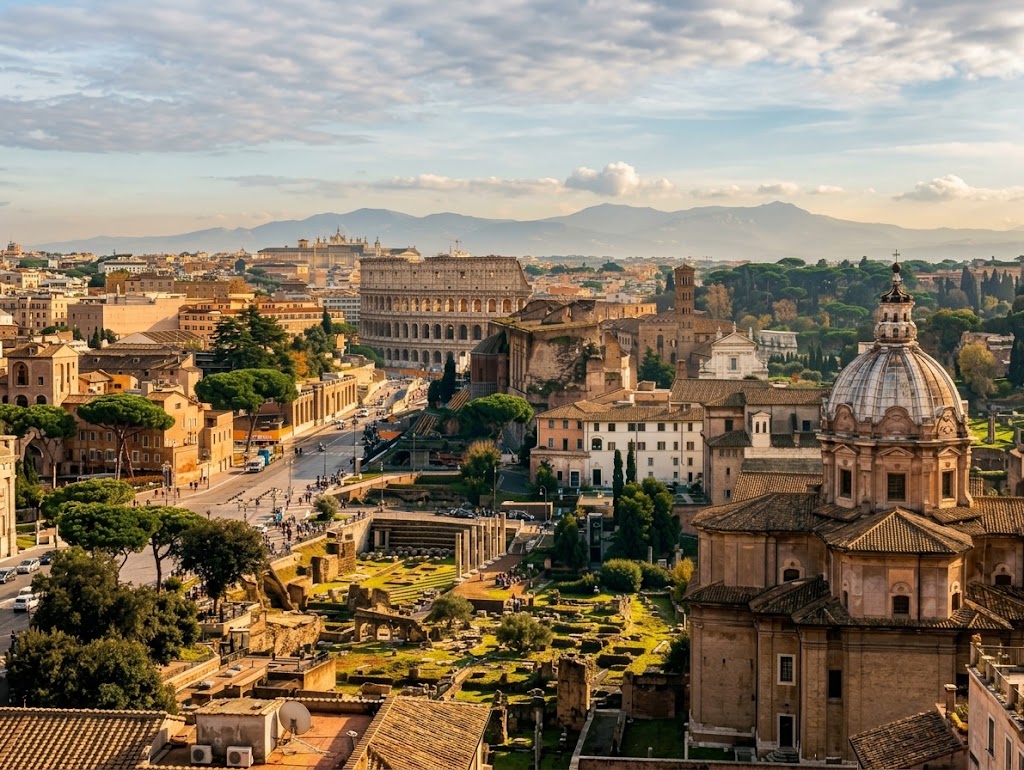
Rome at a Glance
Rome is the capital of Italy, but its identity extends far beyond that of a modern European capital. It is a city of ancient foundations, papal power, artistic patronage, political transformation and everyday rituals that have endured through generations. Its historic centre preserves nearly three millennia of layered history, while the wider city continues to evolve as a place to live, work, study, dine and explore. Few destinations place so many different periods of European history within the reach of an ordinary afternoon walk.
Location and geography.
Situated in the Lazio region of central Italy, Rome developed along the River Tiber, whose course helped shape its early settlement, commerce and expansion. The traditional story of its foundation in 753 BC centres on the seven hills, although the familiar legend of Romulus and Remus belongs to Roman mythology rather than verified historical record. The river remains an important geographical thread through the city, passing ancient bridges, archaeological areas and neighbourhoods such as Trastevere and Testaccio before continuing towards the Tyrrhenian Sea.
A city within a city.
Rome has a distinction that is immediately relevant to anyone exploring its religious and political history: Vatican City, an independent sovereign state, lies within the urban fabric of the Italian capital. The Vatican is the centre of the Roman Catholic Church and a major destination for pilgrims, while Rome itself is home to an extraordinary concentration of churches, basilicas and religious artworks. This proximity has shaped centuries of travel to the city, from medieval pilgrimage to modern visits centred on St Peter’s Basilica, the Vatican Museums and the great papal churches.
History in everyday life.
Rome’s historical layers are not arranged neatly into separate districts or periods. Ancient structures appear beneath later buildings; Renaissance palaces stand beside Baroque churches; archaeological remains emerge between busy roads and residential streets. The city’s role changed dramatically over time: from the centre of the Roman Empire to a major seat of Christian authority, a destination for Renaissance artists and, during the eighteenth and nineteenth centuries, an essential stop on the Grand Tour. That tradition brought aristocrats, writers, painters and scholars to Italy in search of classical learning and artistic inspiration. Rome has continued to attract visitors with different motives ever since, including cultural tourism, religious pilgrimage, education, fashion, gastronomy and leisure.
Language and currency.
Italian is the official language, and the euro (€) is the currency. English is commonly encountered in central visitor areas, major hotels and many restaurants, but a few Italian greetings and courtesies are still worthwhile. Rome is an international destination, yet everyday life continues in Italian neighbourhood shops, traditional markets and family-run establishments beyond the busiest sightseeing routes.
Climate and the rhythm of a visit.
Rome has a Mediterranean climate, with generally hot, dry summers and milder, wetter winters. Spring and autumn are often attractive periods for walking between monuments, spending time in outdoor cafés and exploring neighbourhoods without the intensity of midsummer heat. July and August can bring high temperatures and heavy visitor demand, while major religious events, exhibitions and public holidays can influence crowd levels at other times of year. The best timing depends on whether the priority is outdoor sightseeing, cultural events, quieter streets or the atmosphere of the city at its busiest.
Getting around.
Rome is a city to explore both on foot and by public transport. Many major sights in the historic centre can be linked through walking routes, although distances between areas such as the Vatican, the Colosseum and the northern shopping districts make transport useful. The network includes metro lines, buses and trams, while taxis and app-based services can help with longer journeys or late evenings. Visitors should allow more time than a map might suggest: archaeological areas, restricted-traffic streets, uneven paving and the temptation to stop for a view or a coffee can turn a short journey into a longer one—in the best possible sense.
The practical perspective.
Rome rewards planning, particularly for major attractions with timed entry, popular museums and visits to the Vatican. Booking ahead can reduce uncertainty, but an itinerary built too tightly risks missing the pleasure of the city between appointments. A morning devoted to ancient Rome, an unhurried lunch and an evening walk through a neighbourhood can provide a more rounded impression than attempting to fit every celebrated monument into a single day. The city is vast in history and generous in detail; a first visit can establish its essential landmarks, while subsequent visits offer room for its art, food, design, quieter streets and less familiar corners.
Rome’s Iconic Sights
Rome’s most recognisable sights have travelled far beyond the city itself. They appear in paintings, novels, fashion campaigns, history books and films, becoming part of a shared visual language through which generations have imagined Italy. The Colosseum evokes the scale and spectacle of imperial Rome; the Pantheon reveals the ingenuity of ancient engineering; the Trevi Fountain and Spanish Steps belong to a more romantic image of the city, immortalised on screen and revisited by visitors who recognise them before they arrive. Yet these places are more than familiar backdrops. They have witnessed the changing fortunes of emperors, popes, artists and political leaders, as Rome moved from the centre of an empire to the seat of the Papacy and, eventually, the capital of a unified Italy. Their present appearance is often the result of centuries of alteration, restoration and reinvention. A square that began as an arena might become a public meeting place; an ancient structure might acquire a new religious purpose; a monumental building might come to represent an entirely different political age.
Cinema has given Rome another life. In Roman Holiday (1953), Audrey Hepburn and Gregory Peck turned its streets into the setting for an escapist city adventure; in Federico Fellini’s La Dolce Vita (1960), the Trevi Fountain became one of cinema’s enduring images. Such scenes helped circulate an idea of Rome as a place of elegance, spontaneity and after-dark possibility, while the city’s actual history is considerably more complex. The fascination lies in the contrast: Rome can feel at once monumental and intimate, ceremonial and wonderfully ordinary. For a first visit, a handful of sights provide an essential introduction. They are not the whole story, nor should they be treated as a checklist to complete at speed. Rather, they offer a way into the city—its architecture, public life, artistic ambition and the many different versions of Rome that have accumulated over time.
The Colosseum
The Colosseum is perhaps the most immediately recognisable image of ancient Rome. Opened in AD 80 under Emperor Titus, this immense amphitheatre hosted public spectacles, including gladiatorial contests, and demonstrated the scale of Roman engineering and imperial entertainment. Its surviving arches now stand beside a modern city, making the contrast between ancient power and contemporary life especially vivid. It has also become one of the most enduring visual symbols of Rome in cinema, photography and popular culture.
The Roman Forum and Palatine Hill
Just beyond the Colosseum, the Roman Forum preserves the remains of a district that once formed the political, religious and commercial centre of Roman public life. Temples, basilicas and triumphal arches recall a city whose decisions shaped territories far beyond the Italian peninsula. Nearby, Palatine Hill is associated with Rome’s foundation legends and later imperial residences. Together, these sites offer a sense of how power was expressed through public architecture, ceremony and the physical organisation of the ancient city.
The Pantheon
The Pantheon is one of the most remarkable survivals of ancient Roman architecture. Its vast concrete dome, crowned by an open oculus, creates an interior that feels both monumental and unexpectedly restrained. Rebuilt under Emperor Hadrian in the second century AD, it later became a Christian church, helping preserve the building through centuries of change. Its influence extends well beyond Rome: the Pantheon’s geometry and monumental portico have informed architects across Europe and beyond.
The Trevi Fountain
A theatrical composition of sculpted figures, cascading water and an architectural façade, the Trevi Fountain is among Rome’s most celebrated Baroque works. Completed in the eighteenth century and associated with architect Nicola Salvi, it turns a relatively compact urban setting into a grand piece of public theatre. Its international fame owes something to cinema: the fountain’s appearance in Fellini’s La Dolce Vita helped secure its place in the popular imagination. The familiar coin-tossing ritual adds a lighter dimension to a monument whose design is anything but casual.
The Spanish Steps
The Spanish Steps connect Piazza di Spagna with the church of Trinità dei Monti above, creating one of the city’s most recognisable urban compositions. Completed in the eighteenth century, the staircase has long been part of Rome’s social and cultural landscape. The surrounding streets later became associated with luxury shopping, ateliers and international fashion, giving the area a place in the city’s modern style culture as well as its architectural history. Its cinematic appearances, including in Roman Holiday, have reinforced its reputation as a quintessential Roman setting.
Piazza Navona
Piazza Navona is one of the clearest expressions of Baroque Rome. Its elongated shape follows the footprint of the Stadium of Domitian, built in the first century AD, while its present character reflects the ambition of seventeenth-century patrons and artists. Bernini’s Fountain of the Four Rivers occupies the centre, surrounded by churches, palaces, cafés and the movement of daily city life. It is a useful reminder that Rome’s most compelling public spaces often bring ancient foundations, artistic rivalry, political patronage and contemporary leisure into the same frame.
Piazza del Popolo
At the northern entrance to Rome’s historic centre, Piazza del Popolo was for centuries a principal arrival point for visitors entering the city from the north. Its broad elliptical form, churches, monumental obelisk and connection to the Pincian Hill create a carefully composed introduction to Rome’s historic core. The square also demonstrates how urban planning can turn arrival into a statement: the architecture frames the city and directs movement towards its principal streets.
The Vittoriano and Piazza Venezia
The vast white-marble Monument to Vittorio Emanuele II, commonly known as the Vittoriano, commemorates the first king of unified Italy. Its scale and prominent position near Piazza Venezia make it one of Rome’s most conspicuous modern-era monuments. Unlike the remains of the ancient empire, this is a statement of nineteenth- and twentieth-century national identity, reflecting the political transformation that made Rome the capital of modern Italy. Its commanding terraces also offer a different perspective on the historic centre.
Castel Sant’Angelo
Originally built as a mausoleum for Emperor Hadrian in the second century AD, Castel Sant’Angelo has served several purposes over its long history, including fortress, papal refuge and prison. Its position near the Tiber and its elevated connection to the Vatican area make it an important part of Rome’s architectural and political story. Few buildings demonstrate so clearly how the city repeatedly adapted existing structures to the needs of new rulers and institutions.
The Vatican and Religious Heritage
Few places have shaped the relationship between religion, art and political authority as profoundly as Rome. For centuries, the city has been a destination for pilgrims, a centre of papal power and a meeting point for artists, architects, theologians and political leaders. Its churches and sacred spaces tell stories of faith, but also of patronage, ambition, artistic rivalry and the changing relationship between religious institutions and the societies around them. Here, spiritual devotion and cultural history occupy the same streets—and often the same buildings.
The distinction between Rome and the Vatican is essential. Vatican City is an independent sovereign state enclosed within Rome, established in its present form through the Lateran Treaty of 1929 between the Holy See and Italy. The Holy See, meanwhile, is the governing authority of the Catholic Church and maintains diplomatic relations with countries around the world. The two are closely connected, but they are not interchangeable: Vatican City provides the territorial basis for the Pope’s independence, while the Holy See represents the Church’s central governing authority.
Rome’s importance as a destination for religious travel long predates modern tourism. Pilgrims journeyed to the city to visit the tombs associated with Saints Peter and Paul, pray at its basilicas and participate in major religious celebrations. During the Middle Ages, Rome became one of Christianity’s principal pilgrimage destinations, alongside Jerusalem and Santiago de Compostela. The development of routes, hospices and institutions serving visitors helped shape the city’s relationship with people arriving from across Europe and beyond. Centuries later, the same impulse continues to bring pilgrims to Rome, although their journeys now sit alongside cultural holidays, architectural visits and international events. The 2025 Catholic Jubilee, for example, drew an estimated 33.5 million pilgrims to Rome, according to the Vatican—a striking reminder of the scale of this enduring tradition.
Vatican City and St Peter’s Basilica
The approach to St Peter’s Square is one of the defining encounters of a visit to Rome. Gian Lorenzo Bernini’s monumental colonnade frames the vast piazza, directing attention towards the basilica’s façade and Michelangelo’s dome. The space is designed for more than architectural admiration: it accommodates enormous public gatherings, papal ceremonies and moments of collective religious significance. It is also a political stage, where the Pope addresses the faithful and events within the Vatican can command attention far beyond the square itself. The present St Peter’s Basilica was begun in 1506 and completed in 1626, replacing an earlier basilica commissioned under Emperor Constantine in the fourth century. Its construction became one of the great artistic undertakings of the Renaissance and Baroque periods, involving architects including Bramante, Raphael, Michelangelo and Carlo Maderno, followed by Bernini’s work on the square. The result is a building whose scale is matched by the complexity of its artistic history. Inside, Michelangelo’s Pietà is among the most celebrated works, while the monumental bronze baldachin above the papal altar is one of Bernini’s defining creations. Beneath the basilica lie the Vatican Grottoes and the area associated with the tomb of St Peter, central to the site’s religious significance. Visitors need not share the Catholic faith to appreciate the architecture and artistry, although understanding the basilica’s spiritual purpose gives its scale and symbolism a deeper context.
The Vatican Museums and the Sistine Chapel
The Vatican Museums are among the most significant cultural institutions in Europe, bringing together collections assembled by successive popes over centuries. Their holdings encompass classical sculpture, archaeological material, Renaissance painting, maps, tapestries and works from other artistic traditions. The collections are not simply a record of religious history: they also reveal how the papacy used art, scholarship and patronage to express its authority and participate in wider intellectual life. The museums’ artistic legacy is inseparable from the Renaissance, when leading artists were commissioned to decorate papal apartments and chapels. Raphael’s frescoes in the Raphael Rooms and the extraordinary painted programme of the Sistine Chapel demonstrate the scale of the Church’s investment in art. These commissions brought together religious narratives, classical learning and the ambitions of patrons who understood the power of images to communicate ideas across generations. The Sistine Chapel is perhaps the best-known of these spaces. Its ceiling, painted by Michelangelo between 1508 and 1512, depicts scenes from Genesis, while The Last Judgement, completed on the altar wall in 1541, presents a powerful vision of the Second Coming. The chapel also has an active institutional role: it is where cardinals gather to elect a new Pope in a conclave. Few artistic spaces are so closely associated with both the history of painting and a continuing political and religious process. Its cultural reach extends far beyond the Vatican. The chapel’s imagery has influenced generations of artists and entered popular culture through reproductions, documentaries and cinema. Yet no photograph can fully convey the experience of standing beneath the painted ceiling, where the scale of Michelangelo’s composition and the relationship between the architecture and the figures become apparent.
Rome’s Great Basilicas and Ecclesiastical Heritage
The Vatican is only one part of Rome’s religious landscape. Across the city, churches and basilicas preserve centuries of artistic patronage, architectural change and devotional practice. Four papal major basilicas are especially significant: St Peter’s Basilica in Vatican City, the Archbasilica of St John Lateran, the Basilica of St Mary Major and the Basilica of St Paul Outside the Walls. Each has its own history and religious importance, and together they provide a wider perspective on Rome’s place within the Catholic world. The Archbasilica of St John Lateran holds a particular distinction as the cathedral of the Diocese of Rome and the Pope’s cathedral as Bishop of Rome. Its history reaches back to the early Christian period, and its successive reconstructions reflect the changing architectural tastes and circumstances of the city. St Mary Major, meanwhile, is renowned for its early Christian mosaics and its long association with devotion to the Virgin Mary. St Paul Outside the Walls, built over the traditional burial place of St Paul, offers another perspective on Rome’s early Christian heritage and its enduring role as a destination for pilgrims. Elsewhere, the Basilica of San Clemente reveals Rome’s historical layers in especially tangible form: successive levels beneath the present church preserve evidence of earlier buildings and ancient religious life. Churches such as Santa Maria del Popolo also connect religious patronage with major works of art, including paintings by Caravaggio. Such places demonstrate why Rome’s ecclesiastical heritage belongs as much to the history of art and architecture as it does to religious travel.
Faith, Art and the Modern City
Rome’s religious heritage has never existed apart from the wider history of the city. Papal commissions shaped public spaces and artistic careers; churches became repositories of sculpture, painting and decorative craft; religious ceremonies influenced the movement of people through the capital. The relationship between Church and state has also changed dramatically, particularly during the nineteenth century, when Italian unification brought the Papal States to an end and Rome became the capital of the Kingdom of Italy in 1871. The Lateran Treaty of 1929 subsequently established the present sovereign status of Vatican City. Today, religious travel remains one strand of a much broader visitor economy. Some arrive for prayer or pilgrimage; others come for the architecture, the museums, the art or the historical significance of the Vatican’s institutions. For many, these interests overlap. The same visit might encompass a religious service, an encounter with Michelangelo, a walk through the streets of the historic centre and an evening spent in a neighbourhood restaurant. That is part of what makes Rome’s religious heritage so compelling: it is not confined to one institution or a single period of history. It lives across the city—in monumental basilicas, intimate churches, celebrated works of art and public spaces where centuries of faith, politics and cultural life remain visible.
Museums to Know in Rome
Rome’s museums offer a journey through the city’s many identities: imperial capital, religious centre, artistic powerhouse, cinematic setting and home to generations of Italian design and craftsmanship. Beyond ancient sculpture and Renaissance painting, visitors can discover contemporary art, photography, fashion history and the evolution of Italian cinema, including the legacy of Cinecittà, the celebrated film studios often nicknamed Hollywood on the Tiber. The public appetite for cultural experiences remains substantial: Rome’s 2025 Night of Museums attracted more than 78,000 attendees across over 60 museums and cultural sites, combining exhibitions with performances and other evening events. For visitors, the appeal lies in the variety—whether the interest is a masterpiece, a fashion archive, an archaeological discovery or a glimpse into the art that has shaped the city.
Capitoline Museums
Founded in 1471, the Capitoline Museums are widely recognised as the world’s oldest public museums. Their collections explore Rome’s civic identity through ancient sculpture, inscriptions and archaeological treasures, including the famous bronze Capitoline Wolf. Their position on Michelangelo’s Piazza del Campidoglio makes the buildings themselves part of the experience.
Galleria Borghese
Set within the Villa Borghese gardens, this celebrated gallery brings together works by Bernini, Caravaggio, Raphael and Titian. Bernini’s sculptural groups are particularly compelling for their movement and theatricality, while Caravaggio’s paintings reveal the dramatic use of light and shadow that transformed Baroque art.
National Roman Museum — Palazzo Massimo
One of the four sites of the National Roman Museum, Palazzo Massimo is essential for understanding the artistic sophistication of ancient Rome. Its collections include classical sculpture, mosaics, coins and remarkably preserved frescoes that offer glimpses into the decoration of Roman villas and domestic interiors.
Palazzo Altemps
Housed in a Renaissance palace near Piazza Navona, Palazzo Altemps presents Greek and Roman sculpture amid frescoed rooms and an elegant courtyard. It is particularly appealing to visitors interested in how aristocratic families collected, displayed and interpreted classical art across the centuries.
Baths of Diocletian
Part of the National Roman Museum, the Baths of Diocletian explore the scale of ancient Roman public life through one of the empire’s great bathing complexes. Archaeological objects, inscriptions and the monumental remains of the baths connect everyday social customs with the engineering and urban planning of imperial Rome.
National Gallery of Modern and Contemporary Art (GNAMC)
For a different perspective on Italy’s artistic identity, GNAMC traces developments from nineteenth-century movements to modern and contemporary art. Its collections include works by Italian and international artists, alongside photography, sculpture, installations and design. It offers a useful counterpoint to the classical and Renaissance collections that dominate many visitors’ itineraries.
MAXXI — National Museum of 21st Century Arts
Designed by the late Zaha Hadid, MAXXI is one of Rome’s defining contemporary cultural institutions. Its architecture, with sweeping lines and intersecting interior spaces, is a destination in its own right. Exhibitions explore contemporary art and architecture, placing Rome in conversation with current creative practices rather than treating it solely as a city of the past.
Palazzo Barberini
Home to part of Italy’s National Galleries of Ancient Art, Palazzo Barberini occupies a grand seventeenth-century palace associated with the Barberini family and the era of Baroque patronage. Its collection includes major paintings by artists such as Caravaggio and Raphael. The palace also offers a window into the relationship between artistic ambition, aristocratic wealth and papal power.
Doria Pamphilj Gallery
Still housed within the historic Palazzo Doria Pamphilj, this gallery presents a substantial private collection assembled by one of Rome’s prominent aristocratic families. Paintings by masters including Velázquez, Caravaggio and Titian sit within richly decorated palace interiors. The experience is as much about the history of collecting and noble residences as it is about the individual artworks.
Centrale Montemartini
One of Rome’s most distinctive museum settings, Centrale Montemartini places ancient Roman sculpture and mosaics inside a former power station. Marble figures and archaeological finds stand against industrial machinery, creating an unexpected dialogue between classical art and twentieth-century engineering. It is an especially rewarding stop for visitors interested in design, adaptive reuse and unusual exhibition spaces.
Ara Pacis Museum
The museum houses the Ara Pacis, the Altar of Augustan Peace, commissioned under Emperor Augustus and dedicated in 9 BC. Its intricate reliefs combine religious imagery, ceremonial procession and political symbolism, offering insight into how art helped communicate imperial identity. The contemporary building designed by Richard Meier adds another architectural layer to the site.
Trajan’s Markets — Museum of the Imperial Fora
Set within an extraordinary complex of ancient structures, Trajan’s Markets explore the architecture and urban development of the Imperial Fora. The museum brings together archaeological remains, architectural fragments and reconstructions that help visitors understand how the monumental centre of ancient Rome developed. It is particularly worthwhile for those curious about the relationship between architecture, commerce and imperial government. Rome’s museum landscape extends far beyond these twelve. Smaller collections, historic house museums, photography exhibitions and specialist institutions offer further perspectives on the city’s literature, cinema, politics, design and social history. The best choice depends on the visitor: someone drawn to ancient civilisation may spend a day among archaeological collections, while an admirer of contemporary architecture or modern Italian art will find a very different Rome waiting inside its galleries.
Art in Rome
Rome’s artistic identity cannot be contained within its museums. It unfolds across the city—in the proportions of an ancient temple, the theatrical sweep of a Baroque staircase, the painted ceilings of historic palaces and the modern buildings that challenge the familiar image of the Eternal City. Few places offer such a visible record of changing artistic ambitions, from the engineering of imperial Rome to the patronage of Renaissance popes, the grandeur of Baroque architecture and the experimentation of contemporary designers.
From Ancient Rome to the Renaissance
Ancient Roman architecture was concerned with more than grandeur. Roads, aqueducts, baths, amphitheatres and public buildings helped organise life across an empire, while the use of concrete, arches and vaults enabled structures of extraordinary scale. The Pantheon remains one of the clearest demonstrations of this technical ambition. Its dome, with its central opening to the sky, is both an engineering achievement and a carefully considered architectural experience. During the Renaissance, Rome became a magnet for artists and architects working under papal and aristocratic patronage. Classical forms were studied, reinterpreted and incorporated into new churches, palaces and public spaces. The work of Bramante, Raphael and Michelangelo helped shape the city’s artistic reputation, while commissions for major religious buildings connected architectural ambition with the political and cultural authority of the papacy.
The Drama of Baroque Rome
In the seventeenth century, Baroque art and architecture gave Rome a new visual language of movement, spectacle and emotion. Gian Lorenzo Bernini transformed fountains, sculptures and public spaces into compositions designed to be experienced from multiple viewpoints. Francesco Borromini brought a more experimental approach to architectural form, using curves, geometry and unusual spatial arrangements to create buildings that feel animated rather than static. The result is visible throughout the city. Piazza Navona, the Trevi Fountain and the Spanish Steps each demonstrate how architecture, sculpture, water and movement can turn public space into a form of theatre. These settings have also become part of Rome’s cinematic identity, providing filmmakers with locations that communicate romance, drama and historical depth before a line of dialogue is spoken.
Art, Cinema and the Image of Rome
Rome has long attracted filmmakers because its streets can serve as both a real location and a visual shorthand for an entire culture. Roman Holiday captured the pleasure of exploring the city, while Federico Fellini’s La Dolce Vita presented a more restless world of celebrity, nightlife and post-war social change. The influence of such films extends beyond cinema: they helped shape international ideas of Roman style, café culture, evening dress and the art of being seen in public. That relationship between image and place continues today. Historic courtyards, monumental staircases and palatial interiors remain sought-after settings for fashion photography, advertising and film productions. Yet Rome’s visual identity is not frozen in black-and-white cinema. Contemporary photographers, designers and artists continue to reinterpret its architecture, sometimes celebrating its heritage and sometimes questioning the way the city is represented to the world.
Modern Architecture and Contemporary Creativity
Rome also has an architectural story that reaches beyond antiquity and the historic centre. The EUR district, conceived for a planned international exposition in the Fascist period that never took place because of the Second World War, contains monumental rationalist architecture that reflects a very different chapter of Italian history. Its geometry and scale contrast sharply with the layered streets of central Rome, demonstrating how architecture can express political ambition as well as aesthetic ideals. Contemporary Rome continues to develop through modern cultural institutions, exhibition spaces, design projects and public art. MAXXI, designed by Zaha Hadid, is one of the clearest examples: its flowing concrete forms and intersecting galleries offer a striking counterpoint to the city’s classical order. Alongside contemporary art spaces and repurposed industrial buildings, it shows that Rome’s creative life is still being shaped rather than merely preserved.
Fashion, Craftsmanship and the Roman Setting
Architecture also provides the backdrop to Rome’s fashion identity. Around Piazza di Spagna and Via Condotti, luxury boutiques and historic streets create a distinctive relationship between retail, heritage and public life. The city’s traditions of tailoring, leatherwork, jewellery and couture sit within a wider Italian culture of craftsmanship, while its palaces, courtyards and monumental staircases continue to influence the way fashion houses present their collections and campaigns.
Rome’s Neighbourhoods
Rome’s character changes from one neighbourhood to the next. Within a relatively short journey, visitors can move from Baroque piazzas and luxury boutiques to former working-class districts, traditional food markets, independent galleries and streets shaped by contemporary nightlife. These differences are part of what makes exploring Rome rewarding: the city is not experienced solely through its monuments, but through the places where Romans meet friends, shop, eat, work and spend their evenings. Some neighbourhoods are celebrated destinations in their own right; others are attracting more attention from visitors interested in a less familiar side of the capital. From the historic centre to the creative energy of Pigneto and Ostiense, each offers a different perspective on Rome’s history, artistic life and evolving identity.
Centro Storico
The historic centre is the Rome many visitors imagine before arriving: a network of cobbled streets, Renaissance palaces, Baroque churches, elegant shopping streets and lively piazzas. The Pantheon, Piazza Navona, Campo de’ Fiori and the Trevi Fountain sit within this wider urban fabric. Beyond its architectural splendour, the area remains a place for café culture, independent boutiques, galleries and long evenings around restaurant tables. It is also where Rome’s different historical periods meet most visibly, often within a single street.
Monti
Close to the Colosseum and Roman Forum, Monti combines an ancient setting with a contemporary neighbourhood atmosphere. Once associated with the densely populated Suburra of ancient Rome, it is now known for independent boutiques, vintage clothing, wine bars, small restaurants and the social life around Piazza della Madonna dei Monti. Its appeal lies in the contrast between its historic lanes and its modern creative scene, making it a natural stop for visitors interested in design, fashion and a more intimate side of central Rome.
Trastevere
Across the Tiber, Trastevere is known for narrow lanes, ivy-covered façades, traditional trattorias, artisan shops and an active evening scene. Its photogenic streets have made it one of Rome’s most recognisable neighbourhoods, but there is more to it than its popularity on social media. Historic churches, Renaissance art and small local businesses give the area cultural depth, while its piazzas fill with residents and visitors as the day gives way to night. It is best explored with time to wander rather than a rigid list of stops. 2
Testaccio
For a more food-centred view of Roman life, Testaccio is an essential stop. Its history is closely linked to the city’s former river port, food storage and working-class communities; the hill known as Monte Testaccio was formed from fragments of ancient Roman amphorae. Today, the neighbourhood is associated with traditional Roman cooking, its market, contemporary cultural spaces and a lively local dining scene. It offers a useful reminder that Rome’s food culture is rooted in everyday neighbourhood life as much as in restaurants known internationally.
Prati
Prati offers a different atmosphere from the older streets of central Rome. Developed largely after Italian unification, it is characterised by broad avenues, orderly blocks, substantial residential buildings and a more modern urban layout. Its proximity to the Vatican makes it convenient for visitors exploring St Peter’s Basilica and the Vatican Museums, while Via Cola di Rienzo provides a popular shopping corridor. Prati is also a good area to experience a more everyday version of Rome, with neighbourhood cafés, markets and restaurants serving local residents alongside visitors.
Tridente
The Tridente area takes its name from the three major streets that fan out from Piazza del Popolo towards the historic centre. Around Via del Corso, Via di Ripetta and Via del Babuino, visitors encounter designer boutiques, historic cafés, galleries and some of Rome’s most established luxury-shopping addresses. The nearby Spanish Steps and Via Condotti reinforce the district’s connection with international fashion and Italian craftsmanship. It is one of the clearest places to see Rome’s historic architecture intersect with the contemporary luxury economy.
The Jewish Ghetto
Near the Tiber Island, Rome’s Jewish Ghetto carries a history that is essential to understanding the city’s cultural complexity. Established in 1555 under papal rule, the enclosed ghetto imposed severe restrictions on the Jewish community; those restrictions were abolished in the nineteenth century after the end of papal temporal rule in Rome. Today, the neighbourhood retains a strong cultural identity, with the Great Synagogue, historic streets and a distinctive Roman-Jewish culinary tradition. Its history deserves a thoughtful visit, not simply a quick stop for food or photographs.
Garbatella
For visitors willing to venture beyond the most familiar historic districts, Garbatella offers a distinctive perspective on twentieth-century Rome. Developed from the early 1920s, the neighbourhood is known for its low-rise residential buildings, garden courtyards, communal spaces and winding streets. Its architecture reflects a different idea of urban life from the monumental centre, with a strong emphasis on neighbourhood identity and shared outdoor spaces. Today, local bars, cultural venues and community life make it rewarding for those interested in the social history of the city.
Ostiense
Ostiense has evolved from an industrial and transport district into one of Rome’s more visually distinctive contemporary areas. Former industrial buildings, railway infrastructure and large-scale street art now sit alongside restaurants, cultural venues and creative spaces. The neighbourhood’s industrial architecture provides an alternative backdrop to Rome’s classical and Baroque imagery, while its connection to contemporary art and urban culture attracts visitors looking beyond the traditional sightseeing circuit. It is also a useful area for understanding how former industrial spaces can acquire new cultural and social purposes.
Pigneto and San Lorenzo
East of the historic centre, Pigneto and San Lorenzo offer a younger, more alternative side of Rome. Pigneto is known for its pedestrianised street, independent restaurants, bars and street art; San Lorenzo has a strong student presence, shaped in part by its proximity to Sapienza University. Both districts have connections to Rome’s film and political history, particularly the city’s twentieth-century working-class culture and the Italian neorealist cinema associated with filmmakers such as Roberto Rossellini and Pier Paolo Pasolini. Today, their cafés, bookshops, music venues and late-night social scenes offer a different rhythm from the monumental centre.
Roman Cuisine and Dining Culture
“Life is a combination of magic and pasta,” Federico Fellini once said. It is an apt thought for Rome, where food is inseparable from the city’s daily rhythms, its neighbourhoods and its history. Lunch can begin with a plate of artichokes, move on to pasta dressed with pecorino and black pepper, and finish with an espresso taken at the counter. In the evening, trattorias fill, conversations stretch across tables and recipes passed between generations remain part of everyday life. Rome’s culinary appeal lies not in elaborate technique for its own sake, but in the character of its ingredients, the confidence of its cooking and the stories behind familiar dishes.
The Four Pastas That Define Rome
Few cities have built such a recognisable culinary identity around a handful of pasta dishes. Roman menus return repeatedly to four classics — carbonara, cacio e pepe, amatriciana and gricia — each relying on a small number of ingredients and leaving little room to hide poor execution. Carbonara combines pasta, egg, Pecorino Romano, guanciale and black pepper. Its creamy texture comes from the emulsion of egg, cheese, rendered pork fat and pasta water, rather than cream. The dish’s precise origins remain debated, despite the many stories attached to its creation; what matters at the table is the balance between richness, salt and pepper, with the sauce coating the pasta rather than becoming a heavy scramble. Cacio e pepe is even more stripped back: cheese, black pepper and pasta. Its apparent simplicity is deceptive. The challenge is to combine finely grated Pecorino Romano with hot pasta water to create a smooth sauce, avoiding clumps or a greasy separation. It is a dish in which technique matters as much as the ingredients. Amatriciana brings tomato, guanciale and Pecorino Romano together, traditionally with bucatini or another suitable pasta shape. Its name connects it to Amatrice, a town in Lazio rather than Rome itself, and its place in the capital’s food culture reflects the movement of people and cooking traditions across the region. Gricia uses guanciale, Pecorino Romano and black pepper without tomato. Often described as a close relative of amatriciana, it shows how a small change in ingredients can produce a distinctly different dish. Together, the four pastas illustrate the central principle of Roman cooking: a short ingredient list can produce extraordinary results when each element is treated properly.
More Than Pasta: The Dishes to Know
Pasta may be the international shorthand for Roman food, but it is only one part of the city’s culinary repertoire. Supplì are oblong, fried rice croquettes, commonly filled with tomato-seasoned rice and mozzarella. Break one open while it is hot and the melted cheese stretches between the two halves — the reason for the familiar name supplì al telefono, or telephone supplì. They are classic Roman street food, often eaten as a quick snack or as the opening act before pizza. Saltimbocca alla romana pairs veal with prosciutto and sage, traditionally cooked in a pan with white wine. Its name roughly suggests something that “jumps into the mouth”, an expression that suits a dish built around a few direct, well-matched flavours. Abbacchio, or milk-fed lamb, is another important part of Roman and Lazio cooking, appearing roasted or prepared with herbs and other regional seasonings. Then there is quinto quarto, literally the “fifth quarter”: offal and other cuts left after the more conventionally prized portions of an animal have been divided. Tripe, oxtail, sweetbreads and coratella — a preparation using lamb or kid offal — belong to this tradition. These dishes developed from practical working-class cooking, particularly around Testaccio and Rome’s former slaughterhouse, where cooks transformed inexpensive ingredients into recipes with strong regional identity. They remain an important reminder that Roman cuisine was shaped as much by economic necessity and ingenuity as by the tables of aristocrats and popes.
Artichokes, Puntarelle and the Roman Calendar
Seasonality is central to understanding Roman food. The city’s traditional cooking draws heavily on the produce of the surrounding Lazio countryside, and certain ingredients become particularly anticipated at specific times of year. Artichokes are among the most celebrated. Carciofi alla romana are generally braised with olive oil, garlic, herbs and mentuccia, a mint-like herb associated with Roman cooking. Carciofi alla giudia, the Jewish-style preparation, are opened and fried until their leaves become crisp, creating a very different texture. The two dishes demonstrate how one ingredient can express distinct techniques and culinary histories. Artichokes are especially associated with spring, although availability depends on the season and source. Another local favourite is puntarelle, the crisp shoots of a variety of chicory. They are sliced into thin strips, chilled in water until they curl, then dressed with a punchy mixture traditionally including olive oil, garlic, vinegar and anchovies. Their slight bitterness and crunch make them a characteristic Roman side dish, particularly in the cooler months when the vegetable is in season. Spring also brings vignarola, a dish associated with the countryside around Rome that combines fresh broad beans, peas, artichokes and lettuce, sometimes with guanciale. It is a useful example of how Roman cooking changes with the produce available, rather than relying exclusively on its internationally famous pasta dishes.
The Roman-Jewish Table
Rome’s food history cannot be told without its Jewish community, whose presence in the city stretches back more than two thousand years. The Jewish Ghetto, established under papal rule in 1555 and its restrictions later lifted in the nineteenth century, became the setting for a distinctive culinary tradition shaped by religious practice, local ingredients and centuries of community life. The best-known expression is carciofi alla giudia, but Roman-Jewish cooking extends beyond artichokes. Fried salt cod, anchovy dishes and recipes combining vegetables, fish and seasonal produce reflect a culinary culture that developed in close contact with the wider city while retaining its own identity. The Jewish Ghetto remains an important place to encounter this heritage, not simply as a dining district but as a historic neighbourhood with a living community, religious institutions and a layered past. The distinction matters: Roman-Jewish cuisine is not merely a variation on general Roman cooking. It has its own traditions and history, and its influence is part of what makes the city’s food culture richer than a short list of pasta recipes might suggest.
Markets, Bakeries and the Everyday Food City
Some of Rome’s most revealing food experiences happen before a meal reaches the table. At neighbourhood markets, shoppers select seasonal vegetables, fruit, fish, meat and cheeses; conversations with stallholders and the changing produce reveal a more everyday side of the city than a restaurant menu can convey. Testaccio Market is particularly relevant for visitors interested in the relationship between food and neighbourhood life, given Testaccio’s historic association with the former slaughterhouse and working-class Roman cooking. Markets such as Campo de’ Fiori offer another perspective, though their central location also makes them a familiar stop on sightseeing routes. Bakeries and forni are equally important to the city’s daily rhythm. Roman-style pizza al taglio is baked in large rectangular trays and sold by weight, making it an easy lunch or snack to eat between visits. Its toppings change with the season and the baker’s approach, from simple tomato and mozzarella to vegetables and other combinations. Supplì, fried cod and stuffed courgette flowers also belong to the city’s tradition of casual, often takeaway food. At the other end of the day, the espresso bar remains a small but characteristic part of Roman life. Many people drink their coffee standing at the counter, while breakfast might mean a cappuccino and a cornetto. Later, the aperitivo provides a transition into the evening: a drink before dinner, sometimes accompanied by small snacks. These rituals are not attractions invented for visitors; they are ordinary habits that help explain how food structures the day in Rome.
Trattorias, Osterias and the Pleasure of Eating Slowly
Rome’s traditional dining rooms have their own language. A trattoria generally suggests an informal restaurant focused on familiar cooking, while an osteria historically referred to a more modest establishment associated with wine and simple food. In contemporary Rome, the distinctions are not absolute: names alone do not guarantee a particular style, level of formality or degree of tradition. What matters more is the character of the menu and the way a meal unfolds. Roman dining often begins with a shared starter, moves to a primo — commonly pasta or another first course — and may continue with a secondo of meat or fish and a side dish. Visitors do not need to order every course, and many choose a pasta as their main meal. The point is to understand the structure of the menu rather than feel obliged to follow it in full. Neighbourhoods such as Testaccio and Trastevere, along with Monti and parts of the historic centre, offer opportunities to encounter different expressions of the city’s dining culture. Some establishments maintain recipes closely associated with traditional Roman cooking; others reinterpret local ingredients or place them in a more contemporary setting. Rome’s food scene is not frozen in the past, and the most interesting meals can emerge from the conversation between established techniques and new ideas. A little attention to timing helps. Lunch and dinner hours can differ from those in other countries, and smaller establishments may close between services or on particular days. For a sought-after restaurant, booking ahead is sensible; for a casual meal, walking away from the busiest monument-front terraces can offer more choice and a better sense of the surrounding neighbourhood.
The Sweet Side of Rome
Roman food culture has a place for pastry and dessert, too. Maritozzo, a soft, sweet bun traditionally split and filled with whipped cream, is one of the city’s most recognisable treats. It is particularly associated with breakfast, when it appears in pastry shops alongside cornetti and other baked goods. Its appeal is straightforward: a generous filling, a tender dough and the pleasure of an unhurried coffee break. Gelato is another familiar part of a day in Rome, especially in warmer weather. Look for shops that handle it carefully and present flavours that reflect the ingredients rather than relying only on extravagant displays. Seasonal fruit, nuts, chocolate and classic milk-based flavours can all be worth exploring. In summer, grattachecca — shaved ice flavoured with syrups or fresh fruit — offers a distinctly Roman way to cool down, sold at traditional kiosks around the city. These are small pleasures, but they belong to the wider experience of eating in Rome: a pastry on the way to work, gelato during an evening walk, or something sweet after a long lunch.
Experiencing Rome Through Its Food
The most rewarding way to explore Roman cuisine is to look beyond the dishes that have become famous abroad. Try the four classic pastas, but make room for seasonal vegetables, fried street food, regional meat dishes and the Jewish culinary tradition. Visit a market, step into a bakery, notice how locals use cafés and allow a meal to take place in the neighbourhood rather than treating food as a pause between attractions. Rome’s cooking is often described through its simplicity, but simplicity is only part of the story. Its food reflects migration, religious history, class, agricultural traditions and the ability to make a great deal from a few ingredients. To eat well in Rome is to encounter another form of its cultural heritage — one that is still alive, continually practised and best understood at the table.
Shopping in Rome
Shopping in Rome is closely connected to the city’s artistic and social history. Luxury boutiques occupy streets framed by Renaissance palaces and Baroque façades; historic jewellers sit alongside international fashion houses; independent workshops preserve skills that have passed between generations. Here, fashion is part of the city’s visual culture, shaped by architecture, cinema, Italian craftsmanship and a long tradition of dressing for public life. Rome’s contribution to international style is particularly visible in haute couture, jewellery, leather goods and the relationship between clothing and the settings in which it is presented.
Rome’s Luxury Shopping Streets
The Tridente, the area around Piazza di Spagna and the streets branching towards Piazza del Popolo, is Rome’s principal destination for luxury shopping. Via dei Condotti, Via Borgognona, Via Frattina and Via del Babuino bring together Italian fashion houses, international designers, jewellers and established ateliers. The setting is part of the appeal: shopping unfolds among historic buildings, elegant cafés and streets that have long been associated with Rome’s artistic and social life. Via del Corso offers a broader mix of international brands and more accessible shopping, while Via Cola di Rienzo in Prati is popular for fashion, accessories and everyday retail. For independent boutiques, vintage finds and smaller creative businesses, Monti and parts of Trastevere offer a different experience from the flagship stores around the Spanish Steps. Rome accommodates both ends of the spectrum: established luxury names and the smaller businesses through which personal style often becomes more individual.
The Italian Fashion Houses and Their Roman Connections
Rome has played a defining role in Italian couture, but the histories of its best-known fashion houses are distinct. Valentino Garavani opened his first atelier in Rome in 1959, and Maison Valentino was established in 1960 with Giancarlo Giammetti. The city became central to the designer’s creative life and public identity. His work, celebrated for its precision, colour and formal elegance, helped establish Rome as an international address for haute couture. Piazza Mignanelli, close to the Spanish Steps, remains closely associated with the Maison’s history. Fendi, founded in Rome in 1925, developed from a family business into an internationally recognised house known for leather goods, fur craftsmanship and accessories. Its history is particularly relevant to Rome because the Maison’s identity has remained closely linked to the city, including its association with the Palazzo della Civiltà Italiana in the EUR district. The relationship between Fendi and Rome illustrates how a fashion house can draw from the architecture and character of its home city while operating on a global stage. Bulgari, founded in Rome in 1884, offers another direct connection between the city and international luxury. Its jewellery drew on Roman architectural forms, classical references and the use of richly coloured gemstones, developing a visual language that became recognisable far beyond Italy. The Maison’s historic presence on Via dei Condotti also places it at the centre of Rome’s luxury-shopping district. Jewellery, in this context, is not simply an accessory: it is a form of design that brings together materials, geometry, craft and cultural memory. Other Italian houses are important to the Roman shopping landscape, even though they originated elsewhere. Gucci was founded in Florence in 1921, drawing initially on luggage and leather craftsmanship; Prada began in Milan in 1913, while Giorgio Armani established his fashion house in Milan in 1975. Their boutiques in Rome demonstrate the capital’s importance as an international luxury-shopping destination, rather than making them Roman-founded brands.
From Roman Craft to International Design
Rome’s influence on design extends beyond the names of individual fashion houses. Ancient Roman architecture helped transmit the use of arches, domes, columns, symmetry and monumental proportions across Europe and, later, the wider world. Renaissance and Baroque artists revisited classical forms, adapting them for new buildings, public squares, interiors and decorative objects. These traditions helped shape the visual language of Western architecture and continue to inform contemporary design, from furniture and interiors to luxury retail spaces. The same historical vocabulary appears in fashion and jewellery through classical drapery, sculptural silhouettes, architectural lines, cameos, precious metals and motifs drawn from antiquity. Roman heritage does not account for the entire development of modern Italian craftsmanship—regional traditions across Italy are equally important—but it has supplied an influential visual reference point. In Rome, designers can draw on a particularly concentrated environment of ancient monuments, Renaissance palaces, Baroque interiors and historic artisan practices. Craftsmanship itself is less about a single aesthetic than the knowledge behind an object: the way leather is cut and finished, a garment is constructed, a stone is set, or a decorative surface is worked by hand. Such techniques connect contemporary luxury with traditions of specialist production, even as designers experiment with new materials, technology and more responsible methods of making. Rome’s historic workshops, tailoring traditions, jewellers and costume artisans help keep this relationship between skill and creativity visible.
Fashion, Cinema and the Roman Image
Rome’s international style identity was strengthened by the relationship between fashion and cinema, particularly during the post-war decades. Films such as Roman Holiday and La Dolce Vita brought the city’s streets, cafés, evening culture and distinctive sense of dress to global audiences. Cinecittà’s film studios and Rome’s historic locations also supported generations of costume designers and artisans whose work helped create memorable screen worlds. That connection continues through fashion campaigns, film productions, couture presentations and cultural events staged against the city’s architecture. The appeal is not simply the presence of famous monuments: Rome offers a visual environment where clothing, interiors, public spaces and history can interact. For visitors, this adds another dimension to shopping and design—the opportunity to understand how the city’s image has been created, circulated and continually reinterpreted.
Independent Design, Vintage and Local Craft
Beyond the flagship boutiques, Rome rewards visitors interested in objects with a more individual history. Monti is known for independent shops and vintage clothing; the historic centre contains antique dealers and specialist businesses; neighbourhood markets offer a more everyday view of local commerce. Small workshops, leather specialists, jewellers and artisan businesses can provide a closer encounter with the making and repair of objects than a conventional retail visit. The distinction matters in a city where design is often associated with heritage. An antique piece, a carefully made leather accessory or a garment from an independent designer can reveal a different aspect of Italian craftsmanship from the international luxury names. Visitors interested in buying well may find that the most rewarding purchase is not necessarily the most recognisable label, but an object whose materials, construction and provenance justify its place in a wardrobe or home. Rome’s shopping and design culture ultimately reflects the city itself: internationally recognised yet deeply local, shaped by inherited skills but open to reinvention. From Valentino’s couture heritage and Bulgari’s Roman jewellery tradition to the architecture that continues to inspire designers, the capital offers more than a concentration of luxury stores. It provides a setting in which fashion, craft, art and history remain closely connected.
Gardens and Viewpoints
Rome has a talent for making a simple pause feel like part of the itinerary. A path beneath umbrella pines, the distant sound of church bells, a terrace above terracotta rooftops: the city’s green spaces offer some of its most memorable encounters, often with views that bring its monumental history into a single frame. These gardens were shaped by popes, princes and aristocratic families, but today they belong to a different Roman tradition too — the pleasure of walking, lingering and watching the city carry on around you.
Villa Borghese
The essential starting point is Villa Borghese, a vast historic park in the heart of Rome, developed in the early seventeenth century for Cardinal Scipione Borghese. Its paths wind past fountains, sculptures, ornamental gardens and small lakes, while neoclassical structures and centuries-old trees give the grounds the atmosphere of an urban landscape designed for leisurely exploration. The park also contains the Galleria Borghese, making it possible to combine a walk with one of Rome’s most distinguished art collections. For a quieter interlude, the lake and its Temple of Aesculapius are among the most appealing places to pause.
The Orange Garden
On the Aventine Hill, Giardino degli Aranci, officially the Savello Park, is one of Rome’s most rewarding places to take in the skyline. Orange trees shade the paths, and the terrace opens towards the Tiber and the city’s historic centre, with the dome of St Peter’s forming a familiar point on the horizon. The garden is compact enough to visit without committing half a day, yet the view encourages visitors to stay longer than planned. It is particularly atmospheric towards sunset, when the light softens across the rooftops and domes.
The Pincio Terrace
Overlooking Piazza del Popolo from the edge of Villa Borghese, the Pincio Terrace offers one of the city’s classic panoramas. From here, Rome’s domes and rooftops spread towards the horizon, with the broad outline of St Peter’s visible in the distance. The terrace is especially appealing in the late afternoon, when the changing light gives the view a cinematic quality. It also makes a natural stop after exploring Villa Borghese or the nearby streets around Piazza di Spagna and Via del Corso.
Villa Doria Pamphilj
For a more expansive escape, Villa Doria Pamphilj is Rome’s largest landscaped public park, extending across roughly 184 hectares in the west of the city. Once a noble country estate associated with the Pamphilj family, it preserves historic avenues, fountains, woodland paths and formal gardens around the Casino del Bel Respiro. Its scale makes it better suited to a longer walk than a quick stop between central sights; visitors come here to run, cycle, picnic or simply spend time away from the busiest streets.
The Botanical Garden of Rome
Set on the slopes of the Janiculum between Trastevere and the Tiber, the Botanical Garden of Rome offers a different kind of retreat. Its collections include Mediterranean and exotic plants, wooded paths and landscaped areas that make it a rewarding choice for visitors interested in horticulture as well as the city’s built heritage. It is a particularly good alternative for those who have already seen the central viewpoints and want to experience a quieter, greener side of Rome. These places need not become another checklist. Choose one panoramic terrace and one garden that suits the pace of the day; Rome’s green spaces are best enjoyed with enough time to wander, sit down and let the city come into view.
Other Experiences
Beyond its ancient monuments and celebrated museums, Rome has a cultural life that rewards visitors who make time for an evening performance, a concert in a historic setting or a film festival bringing international cinema to the city. Opera and ballet at Teatro dell’Opera di Roma, orchestral performances at the Auditorium Parco della Musica and special events staged among the capital’s historic landmarks offer different ways to experience Rome, each shaped by its artistic traditions and contemporary cultural scene. Some experiences depend on the season or the dates of a visit, making advance planning worthwhile. Whether attending a major theatrical production, discovering Italian cinema or finding a one-off performance in an extraordinary venue, these are opportunities to experience Rome beyond its familiar landmarks.
An Evening at the Rome Opera House
An evening at Teatro dell’Opera di Roma offers an opportunity to experience Italy’s operatic tradition in a historic theatrical setting. The programme features opera, ballet and selected concerts, bringing together established works and contemporary productions. For visitors who appreciate the performing arts, attending a performance adds a cultural dimension to a stay in the Italian capital. Check the seasonal programme for performances during your visit.
Classical Music at the Auditorium Parco della Musica
Designed by architect Renzo Piano, the Auditorium Parco della Musica Ennio Morricone is one of Rome’s principal venues for live music and cultural events. Its programme spans orchestral concerts, classical recitals, jazz and contemporary performances, with internationally recognised musicians appearing alongside Italian artists. An evening here offers a different perspective on the city, particularly for visitors who want to explore Rome’s contemporary cultural scene beyond its historic landmarks.
Open-Air Performances at the Circus Maximus
Once the setting for chariot races in ancient Rome, the Circus Maximus continues to host large-scale events in a setting steeped in history. During selected summer seasons, the venue becomes a stage for opera, dance, symphonic music and other cultural productions. Watching a performance beneath the evening sky, surrounded by the remains of ancient Rome, can be a memorable addition to a summer visit. Events and programming vary by year, so check the schedule before planning an evening here.
Discover Rome Through Its Film Festival
The Rome Film Fest brings international cinema to the Italian capital through film premieres, screenings, discussions and special appearances by filmmakers and actors. Centred around the Auditorium Parco della Musica and other participating venues, the festival offers visitors an opportunity to discover new films and engage with the people behind them. If your visit coincides with the festival, it is an excellent way to experience a different side of Rome’s cultural life.
A Cinema Evening at Casa del Cinema
Set within Villa Borghese, Casa del Cinema is a cultural venue dedicated to film screenings, retrospectives and programmes celebrating Italian and international cinema. Depending on the schedule, visitors may discover classic films, works by celebrated directors or themed screenings that offer a deeper appreciation of cinematic history. Its location within one of Rome’s most beautiful parks makes it a particularly appealing option for those seeking a quieter cultural evening away from the busiest tourist areas.
Classical Concerts in Historic Churches
Rome’s churches and basilicas provide settings for selected classical, choral and sacred-music performances, bringing together the city’s musical heritage and its extraordinary religious architecture. Depending on the programme, visitors may encounter chamber music, organ recitals or vocal performances in spaces whose artistic significance extends well beyond their religious function. Choose a concert with a confirmed programme and venue, as performance schedules vary throughout the year.
Discover Rome After Hours
Some of Rome’s most compelling cultural experiences take place beyond regular museum visiting hours. Special evening programmes, guided archaeological visits and limited-run events can offer a different perspective on the city’s historic sites and collections. The Domus Aurea, Nero’s vast imperial residence, is particularly fascinating to explore through its scheduled guided visits, while special programmes at museums such as the Ara Pacis may incorporate sound, visual technology and storytelling. Availability varies, so check current arrangements and book ahead where necessary.
When to Visit Rome and Planning a Visit
Rome changes with the seasons, and the timing of a visit can shape everything from how long you want to spend outdoors to how comfortably you can explore its archaeological sites. Spring brings flowering gardens and mild days; summer stretches into warm evenings but can make sightseeing tiring in the heat; autumn offers comfortable conditions and a renewed cultural calendar; winter brings cooler weather, festive streets and, outside major holiday periods, opportunities to experience the city at a different pace. There is no single perfect month — the best time depends on whether your priorities are outdoor exploration, art and museums, religious events or simply enjoying Rome’s everyday life.
Choosing the Right Season
Spring (March–May) is one of the most appealing periods for walking, exploring archaeological sites and spending time in Rome’s gardens and piazzas. Temperatures are generally more comfortable than in high summer, although showers are possible and Easter can bring particularly heavy demand, especially around the Vatican. If travelling during Holy Week or a Jubilee-related event, check dates and access arrangements well in advance.
Summer (June–August) brings long days, outdoor dining and a lively evening atmosphere, but July and August can be very hot. Archaeological sites and long stretches of sightseeing in direct sun may become tiring, so plan major outdoor visits for the morning, take a break during the hottest part of the day and return to the streets later. Some independent businesses may reduce their hours or close for holidays, particularly in August, so check individual venues before visiting.
Autumn (September–November) is often an excellent time for a balanced city break. September can remain warm and busy, while October and November tend to bring cooler conditions that suit walking and cultural visits. The season also provides opportunities to explore Rome’s food traditions as restaurants and markets reflect the changing produce of the year. Rain becomes more likely later in autumn, making a flexible indoor alternative useful.
Winter (December–February) offers a quieter atmosphere in parts of the city, although Christmas, New Year and major religious occasions can still draw substantial crowds. Cooler temperatures and occasional rain favour a mix of museums, churches, long lunches and shorter outdoor walks. December brings seasonal decorations and Christmas markets, while visitors interested in religious history may find the period around Christmas particularly meaningful. Always check opening times, as holidays can affect individual attractions.
Managing Crowds and Booking Ahead
Rome’s most famous sights are popular throughout the year, and demand rises during Easter, public holidays, school breaks and major events. Reserve timed-entry tickets for high-demand attractions such as the Colosseum, the Vatican Museums and the Galleria Borghese as early as the official booking windows allow. Buy through the attraction’s official website wherever possible, and check what the ticket includes before paying a third-party seller. Starting early can make a significant difference at outdoor archaeological sites and busy landmarks. It is also worth avoiding an itinerary that moves between several timed-entry attractions in a single day: queues, security checks, walking distances and the city’s irregular street layout can all take longer than expected. Leave room for an unplanned church visit, a café stop or a change of pace.
Getting Around Rome
The historic centre is best explored on foot, but distances between neighbourhoods and outlying sites can be considerable. Comfortable shoes are essential: many streets have uneven paving, and archaeological areas often involve steps and rough surfaces. The metro, buses and trams are useful for longer journeys, while taxis can help when travelling late or crossing the city with luggage. Rome’s public transport operator, ATAC, offers single-journey and time-based tickets, including 24-, 48- and 72-hour options. Check the current fares and conditions on the official ATAC website before travelling, and validate your ticket as required. Airport transfers have separate rules: for example, the Leonardo Express train from Fiumicino to Roma Termini requires its own ticket and is not covered by ordinary city transport tickets.
How Much Time Should You Allow?
Three days can provide a rewarding first introduction if you prioritise the ancient city, the Vatican and a selection of neighbourhoods, but it requires some decisions about what to leave for another visit. Four to five days allows a more comfortable balance of major sights, museums, food, shopping and time spent exploring beyond the busiest areas. With a week or longer, you can move at a gentler pace and consider places beyond the central tourist circuit. Whichever length of stay you choose, group visits by area rather than crossing the city repeatedly. Pair nearby sights, leave space between reservations and resist the temptation to fit every famous name into one itinerary. Rome is a city of layers, and some of its best moments happen when the schedule allows you to notice them.
A Few Practical Details
Italy uses the euro, and Italian is the official language. English is widely understood in many central hotels, museums and visitor-facing businesses, but learning a few Italian greetings is appreciated. Keep an eye on personal belongings in crowded transport hubs and busy tourist areas, carry water in warm weather and check the latest opening times, entry rules and transport information before setting out. For current events, local guidance and official visitor information, Turismo Roma maintains an updated city tourism portal. The most satisfying visit to Rome is rarely the one with the fullest schedule. Choose the season that suits your interests, plan the essentials carefully and leave enough time to experience the city between its famous sights — at a market, over a long meal or on a street you had no particular reason to take.
